
Super TET 2026 Syllabus – Primary & Junior Teacher (Based on UPESSC Advt. No. 05/2026)
Both examinations consist of 120 objective questions for 360 marks within a 120-minute time limit, featuring a +3 mark reward for correct answers and a -1 mark negative marking penalty. Below, you can download the verified official syllabus PDFs, inspect visual document previews, review topic-wise breakdowns, and explore dedicated study guides.
सुपर टेट सिलेबस 2026: प्राथमिक एवं जूनियर शिक्षक परीक्षा पाठ्यक्रम
हिंदी सारांश (Hindi Overview)उत्तर प्रदेश शिक्षा सेवा चयन आयोग (UPESSC) द्वारा प्रस्तावित Super TET 2026 परीक्षा पाठ्यक्रम के अनुसार कुल 120 बहुविकल्पीय प्रश्न (MCQs) पूछे जाएंगे। परीक्षा की कुल अवधि 120 मिनट (2 घंटे) होगी और अधिकतम 360 अंक निर्धारित हैं। परीक्षा में प्रत्येक सही उत्तर के लिए +3 अंक दिए जाएंगे तथा प्रत्येक गलत उत्तर पर -1 अंक की नेगेटिव मार्किंग (1/3 नकारात्मक अंकन) लागू होगी।
14 व्यक्तिगत विषय (10 संयुक्त परीक्षा समूह): सामान्य ज्ञान व समसामयिकी (25 प्रश्न / 75 अंक), तार्किक ज्ञान (5 प्रश्न / 15 अंक), भाषा समूह — हिन्दी, संस्कृत, अंग्रेजी (30 प्रश्न / 90 अंक), विज्ञान (8 प्रश्न / 24 अंक), गणित (16 प्रश्न / 48 अंक), पर्यावरण एवं सामाजिक अध्ययन (8 प्रश्न / 24 अंक), शिक्षण कौशल (8 प्रश्न / 24 अंक), बाल मनोविज्ञान (8 प्रश्न / 24 अंक), सूचना तकनीकी (4 प्रश्न / 12 अंक), जीवन कौशल, प्रबंधन व अभिवृत्ति (8 प्रश्न / 24 अंक) — कुल 120 प्रश्न / 360 अंक।
दो मुख्य खंड: खंड 1 (अनिवार्य): सामान्य ज्ञान, समसामयिकी व तार्किक ज्ञान (30 प्रश्न / 90 अंक)। खंड 2 (विषय विशेषज्ञता): अभ्यर्थी के स्नातक विषय वर्ग अनुसार — भाषा (हिन्दी/अंग्रेजी/संस्कृत), सामाजिक अध्ययन, या गणित एवं विज्ञान (90 प्रश्न / 270 अंक)।
Super TET 2026 Syllabus at a Glance
Direct summary of the verified 2026 examination structure based on the official UPESSC recruitment curriculum:
Primary Teacher (PRT)
- Teacher Category: Classes 1–5 (Primary Teacher)
- Total Questions: 120 MCQs
- Total Marks: 360 Marks (+3 / -1)
- Time Duration: 120 Minutes (2 Hours)
- Curriculum Scope: 14 Subjects (10 Groups)
- Academic Benchmark: Up to Class 12 Level
- Pedagogy Benchmark: Up to D.El.Ed Level
- Question Paper Language: Bilingual (Hindi & English)
Junior Teacher (Upper Primary)
- Teacher Category: Classes 6–8 (Junior Teacher)
- Total Questions: 120 MCQs
- Total Marks: 360 Marks (+3 / -1)
- Time Duration: 120 Minutes (2 Hours)
- Section 1 (Compulsory): 30 Questions (GK & Reasoning)
- Section 2 (Specialized): 90 Questions (Chosen Pathway)
- Specialization Streams: Language / SST / Maths-Science
- Subject Benchmark: Graduation Degree Standard
Super TET 2026 Syllabus PDF
Official curriculum notices issued by the Uttar Pradesh Education Service Selection Commission (UPESSC, Prayagraj).
Primary Teacher Syllabus PDF
Contains the official notification blueprint, 120-question marks distribution, marking scheme (+3, -1), difficulty benchmarks (Class 12 / D.El.Ed), and detailed syllabi for all ten domains.
Junior Teacher Syllabus PDF
Contains the official Upper Primary syllabus framework, Section 1 compulsory General Knowledge (30 Qs), and comprehensive topic syllabi for Section 2 pathways: Language, Social Studies, and Science-Mathematics.
This syllabus guide summarizes the factual 2026 recruitment blueprints issued by the Uttar Pradesh Education Service Selection Commission (UPESSC), 23 Allengunj, Prayagraj. SuperTET.com provides unedited official PDF files above for direct candidate reference. While our editorial team maintains strict fidelity with official notifications, candidates should verify any subsequent corrigendum or gazette notifications released at the official commission portal (upessc.up.gov.in).
Note: SuperTET.com is an independent educational platform. We do not represent any government agency or conduct state examinations.
1. Super TET 2026 Syllabus Overview
The Super TET (Super Teacher Eligibility Test) Syllabus serves as the official curriculum boundary for candidates competing for Assistant Teacher appointments in government primary and upper primary schools across Uttar Pradesh. Administered under the newly constituted Uttar Pradesh Education Service Selection Commission (UPESSC), this competitive examination is taken only by candidates who have previously qualified either the Uttar Pradesh Teacher Eligibility Test (UPTET) Paper 1 or Paper 2, or the Central Teacher Eligibility Test (CTET).
To prepare effectively, candidates must understand the precise distinctions between key examination terminology:
The exact list of subjects, knowledge domains, and specific topic themes tested in the examination.
The quantitative structure: 120 questions, 360 marks, 120 minutes, +3 reward, and -1 penalty. Detailed on our Exam Pattern guide.
The textbooks, SCERT/NCERT chapters, and notes used to master the syllabus topics. Explore our Study Material library.
Unlike basic eligibility tests, the Super TET syllabus tests both academic knowledge (Languages, Science, Mathematics, Social Studies) and professional teacher capability (Pedagogical skills, Child psychology, Educational ICT, and Professional life skills). Studying directly from the official notification syllabus ensures that you do not waste time on extraneous subjects while covering every tested competency.
Super TET 2026 Syllabus for Primary Teacher
The Primary Teacher examination selects Assistant Teachers for elementary schools (कक्षा 1 से 5). Under the 2026 UPESSC framework, the exam comprises 14 individual subjects organized into 10 combined examination groups totaling 120 multiple-choice questions for 360 marks. Every question has four options with a single correct response. Correct answers earn 3 marks, while incorrect answers penalize 1 mark. The question paper is bilingual (English and Hindi).
Candidates frequently ask whether the Super TET Primary examination contains 10 or 14 subjects. Both descriptions refer to the same official syllabus: the UPESSC curriculum specifies 14 individual academic and pedagogical subjects (GK/Current Affairs, Reasoning, Hindi, English, Sanskrit, Science, Mathematics, Environmental Studies, Social Studies, Teaching Methodology, Child Psychology, Information Technology, Life Skills, and Professional Management & Attitude), which are structured into 10 composite question groups on the examination paper (totaling 120 questions and 360 marks).
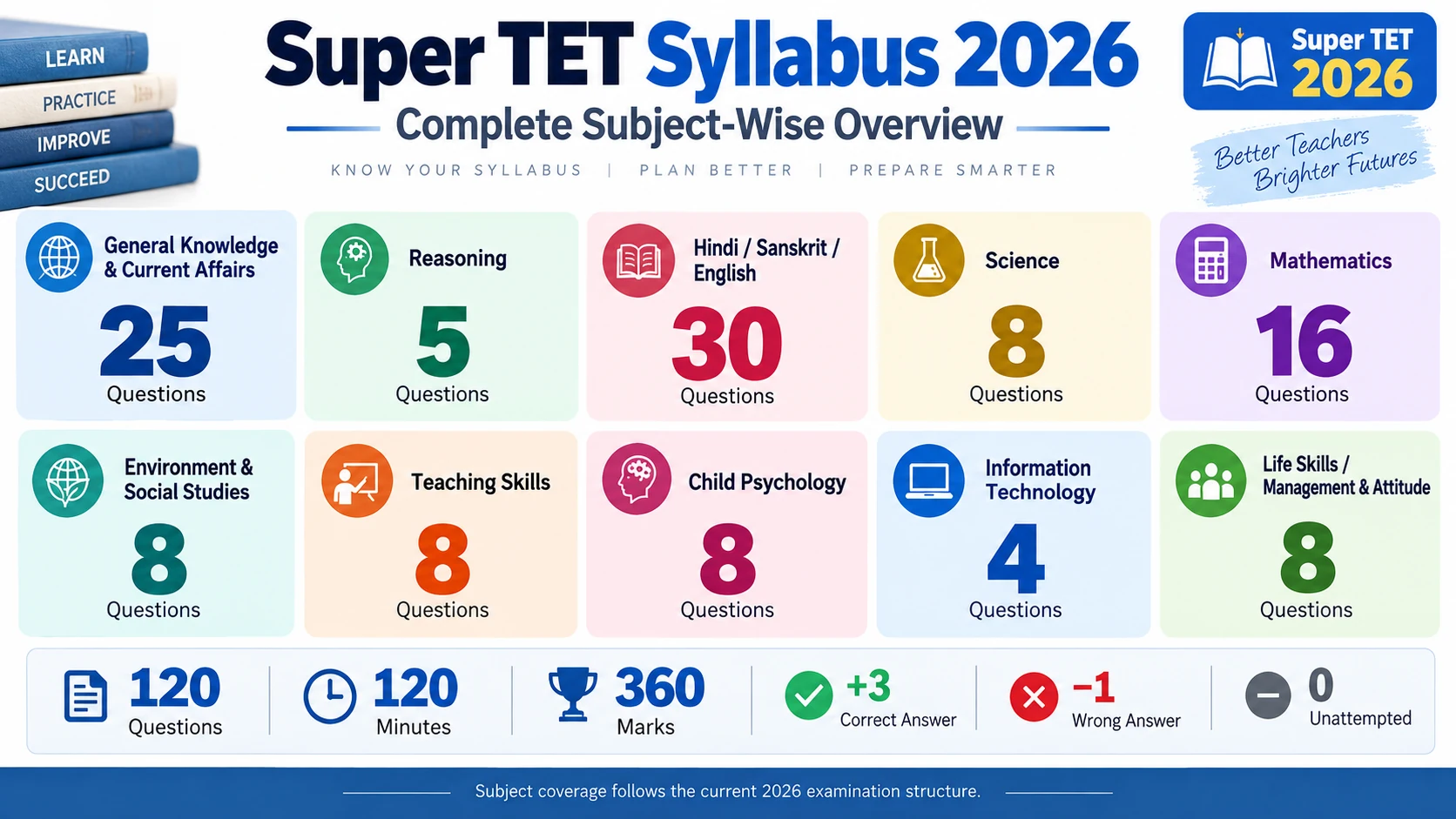
Primary Teacher Subject-wise Question & Marks Distribution (14 Subjects across 10 Groups)
| Subject / Domain | Questions | Total Marks | Official Difficulty Benchmark |
|---|---|---|---|
| General Knowledge / Current Affairs (सामान्य ज्ञान / समसामयिक घटनाएं) | 25 | 75 | National, International & UP State Significance |
| Reasoning Ability (तार्किक ज्ञान) | 5 | 15 | General Mental Ability & Logic |
| Languages: Hindi, Sanskrit & English (हिन्दी, संस्कृत तथा अंग्रेजी) | 30 | 90 | Up to Senior Secondary (Class 12 Standard) |
| Science (विज्ञान) | 8 | 24 | Up to Senior Secondary (Class 12 Standard) |
| Mathematics (गणित) | 16 | 48 | Up to Senior Secondary (Class 12 Standard) |
| Environment & Social Studies (पर्यावरण एवं सामाजिक अध्ययन) | 8 | 24 | Up to Senior Secondary (Class 12 Standard) |
| Teaching Skills (शिक्षण कौशल) | 8 | 24 | D.El.Ed / B.T.C. Curriculum Standard |
| Child Psychology (बाल मनोविज्ञान) | 8 | 24 | D.El.Ed / B.T.C. Curriculum Standard |
| Information Technology (सूचना तकनीकी) | 4 | 12 | D.El.Ed / B.T.C. Curriculum Standard |
| Life Skills / Management & Attitude (जीवन कौशल/प्रबन्धन एवं अभिवृत्ति) | 8 | 24 | D.El.Ed / B.T.C. Curriculum Standard |
| Grand Total | 120 | 360 | Duration: 120 Minutes (2:00 Hours) |
Primary Subject-by-Subject Syllabus Breakdown
1. General Knowledge & Current Affairs (सामान्य ज्ञान / समसामयिक घटनाएं)
25 Questions • 75 MarksOfficial Syllabus Content: समसामयिक महत्वपूर्ण घटनाएँ- अन्तर्राष्ट्रीय, राष्ट्रीय, प्रदेश (उत्तर प्रदेश) से सम्बन्धित महत्वपूर्ण घटनाएँ, स्थान, व्यक्तित्व, रचनाएँ, अन्तर्राष्ट्रीय तथा राष्ट्रीय पुरस्कार/खेल-कूद, भारतीय संस्कृति एवं कला आदि।
This is the second-largest section of the Primary exam. It requires systematic tracking of monthly national events, state initiatives of Uttar Pradesh, sports tournaments, major literary awards, and prominent cultural festivals.
2. Reasoning Ability (तार्किक ज्ञान)
5 Questions • 15 MarksOfficial Syllabus Content: Analogies, Assertion and reason, Binary logic, Classification, Clocks and Calendars, Coded inequalities, Coding & decoding, Critical reasoning, Cubes, Number series, Puzzles, Symbols and notations, Venn diagrams and dice, Data interpretation, Direction sense test, Grouping and selections, Inferences, Letter series.
3. Languages: Hindi, Sanskrit & English (हिन्दी, संस्कृत तथा अंग्रेजी)
30 Questions • 90 MarksOfficial Syllabus Content: व्याकरण एवं अपठित गद्यांश, पद्यांश (Grammar and Unseen Comprehension Passages across all three languages).
Critical Curriculum Grouping: The official 2026 notification lists Hindi, Sanskrit, and English together under a single 30-question allocation (carrying 90 marks). Candidates should not rely on unofficial claims splitting this into arbitrary sub-quotas without official notification support. Academic difficulty is benchmarked up to the Senior Secondary (Class 12) standard.
4. Science (विज्ञान)
8 Questions • 24 MarksOfficial Syllabus Content: दैनिक जीवन में विज्ञान, गति, बल, ऊर्जा, दूरी, प्रकाश, ध्वनि, जीवों की दुनिया, मानव शरीर स्वास्थ्य, स्वच्छता एवं पोषण, पर्यावरण एवं प्राकृतिक संसाधन, पदार्थ एवं पदार्थ की अवस्थाएँ।
Science evaluates general principles of physics, chemistry, biology, and everyday scientific phenomena up to the Class 12 standard.
5. Mathematics (गणित)
16 Questions • 48 MarksOfficial Syllabus Content: अंकीय क्षमता, गणितीय संक्रियाएँ, दशमलव, स्थानीयमान, भिन्न, ब्याज (साधारण व चक्रवृद्धि), लाभ-हानि, प्रतिशत, विभाज्य, गुणनखण्ड, ऐकिक नियम, सामान्य बीजगणित, क्षेत्रफल, औसत, आयतन, अनुपात, सर्वसमकायें, सामान्य ज्यामिति, सामान्य सांख्यिकी।
With 16 questions (48 marks), Mathematics represents the highest-weight single academic subject. Conceptual clarity and speed in arithmetic, basic algebra, and mensuration are essential.
6. Environment & Social Studies (पर्यावरण एवं सामाजिक अध्ययन)
8 Questions • 24 MarksOfficial Syllabus Content: पृथ्वी की संरचना, नदियाँ, पर्वत, महाद्वीप, महासागर व जीव, प्राकृतिक सम्पदा, अक्षांश और देशान्तर, सौरमण्डल, भारतीय भूगोल, भारतीय स्वतंत्रता संग्राम, भारतीय समाज सुधारक, भारतीय संविधान, हमारी शासन व्यवस्था, यातायात एवं सड़क सुरक्षा, भारतीय अर्थव्यवस्था एवं चुनौतियाँ, हमारी सांस्कृतिक विरासत, पर्यावरण संरक्षण, प्राकृतिक आपदा प्रबन्धन।
7. Teaching Skills (शिक्षण कौशल)
8 Questions • 24 MarksOfficial Syllabus Content: शिक्षण की विधियाँ एवं कौशल, शिक्षण अधिगम के सिद्धान्त, वर्तमान भारतीय समाज एवं प्रारम्भिक शिक्षा, समावेशी शिक्षा, प्रारम्भिक शिक्षा के नवीन प्रयास, शैक्षिक मूल्यांकन एवं मापन, आरम्भिक पठन कौशल, शैक्षिक प्रबन्धन एवं प्रशासन।
8. Child Psychology (बाल मनोविज्ञान / CDP)
8 Questions • 24 MarksOfficial Syllabus Content: वैयक्तिक भिन्नता, बाल विकास को प्रभावित करने वाले कारक, सीखने की आवश्यकता की पहचान, पढ़ने के लिए वातावरण का सृजन करना, सीखने के सिद्धान्त तथा कक्षा-शिक्षण में इनकी व्यावहारिक उपयोगिता एवं प्रयोग, दिव्यांग छात्रों हेतु विशेष व्यवस्था।
9. Information Technology (सूचना तकनीकी)
4 Questions • 12 MarksOfficial Syllabus Content: शिक्षण कौशल विकास, कक्षा-शिक्षण तथा विद्यालय प्रबन्धन के क्षेत्र में सूचना तकनीकी, कम्प्यूटर, इन्टरनेट, स्मार्टफोन, ओ०ई०आर० (ओपन एजुकेशनल रिसोर्स / Open Educational Resources), शिक्षण में उपयोगी एप्स, डिजिटल शिक्षण सामग्री के उपयोग की जानकारी।
10. Life Skills / Management & Attitude (जीवन कौशल / प्रबन्धन एवं अभिवृत्ति)
8 Questions • 24 MarksOfficial Syllabus Content: व्यावसायिक आचरण एवं नीति, प्रेरणा, शिक्षण की भूमिका (सुविधा प्रदाता, अनुश्रवणकर्ता, नेतृत्वकर्ता, मार्गदर्शक, परामर्शदाता), संवैधानिक और मानवीय मूल्य, दण्ड एवं पुरस्कार व्यवस्था का प्रभावी प्रयोग।
Super TET 2026 Syllabus for Junior Teacher
The Junior High School Assistant Teacher (उच्च प्राथमिक विद्यालय सहायक अध्यापक) recruitment examination covers appointments in Classes 6 to 8. The examination features a single question paper structured into two distinct sections totaling 120 questions for 360 marks:
Section 1: General Knowledge (सामान्य ज्ञान)
Mandatory for every candidate regardless of their subject specialization. Comprises 30 questions (90 marks) testing Current Affairs, Indian History & National Movement, Geography, Polity & Governance, Socio-Economic Development, Environment & Ecology, General Science, and Reasoning Ability.
Section 2: Selected Teaching Subject (सम्बन्धित विषय)
A specialized discipline paper of 90 questions (270 marks) drawn from the candidate's chosen graduation stream. Candidates must select exactly one subject pathway: Language, Social Studies, or Science & Mathematics.
Junior Section 2 Subject Pathways (90 Questions)
Candidates choose one of the following three pathways based on their academic graduation qualifications:
Candidates select one language studied at the degree level:
- Hindi (हिन्दी): साहित्य एवं भाषा का इतिहास, व्याकरण, अपठित गद्यांश/पद्यांश, प्रमुख रचनाकार।
- English: History of English Literature & Language, Grammar, Unseen Passage, Writers/Poets.
- Sanskrit (संस्कृत): भाषा एवं साहित्य का इतिहास, व्याकरण, अपठित गद्यांश/पद्यांश, प्रमुख कृतियाँ।
For candidates qualifying in Humanities, Arts, and Social Sciences.
- Ancient, Medieval & Modern Indian History
- Indian National Movement & Freedom Struggle
- Indian Constitution, Polity, Judiciary & Governance
- Physical & Economic Geography of India and UP
- Ecology, Environment Protection & Waste Management
For candidates with BSc or degree-level qualifications in Mathematics, Physics, Chemistry, or Life Sciences.
- Mathematics: Number system, Algebra, Equations, Ratio, Banking, Geometry, Mensuration, Statistics.
- Science: Everyday science, Mechanics, Heat, Light, Electricity, Cell biology, Human body, Chemistry, Periodic table.
Super TET 2026 Exam Pattern
Candidates preparing for teacher recruitment in Uttar Pradesh must recognize that the Primary and Junior examinations demand completely different preparation mindsets. Here is how they compare across all key parameters:
| Examination Dimension | Primary Teacher (PRT) | Junior Teacher (Upper Primary) |
|---|---|---|
| Teaching Level | Classes 1 to 5 (Elementary School) | Classes 6 to 8 (Upper Primary / Middle School) |
| Paper Format | Single paper: 14 subjects across 10 groups | Single paper: Section 1 (GK) + Section 2 (Subject) |
| Total Questions / Marks | 120 MCQs • 360 Marks | 120 MCQs • 360 Marks |
| Marking Scheme | +3 for correct • -1 for incorrect | +3 for correct • -1 for incorrect |
| Exam Duration | 120 Minutes (2 Hours) | 120 Minutes (2 Hours) |
| Candidate Specialization | Generalist: Every candidate answers all 14 subjects (10 groups) | Specialist: Candidates choose 1 of 3 graduation pathways |
| Academic Level | Core subjects up to Class 12 standard | Subject specialization up to Degree/Graduation level |
| Pedagogy Level | Teaching Skills & CDP at D.El.Ed level (24 Qs) | Integrated within subject pedagogy & general knowledge |
| Language Section | Hindi, Sanskrit, English tested collectively (30 Qs) | Language candidates choose 1 language in depth (90 Qs) |
| Dedicated Guide | Primary Syllabus Guide → | Junior Syllabus Guide → |
5. Subject-wise Super TET Syllabus Resource Directory
For comprehensive topic-by-topic coverage, chapter breakdowns, and subject-specific preparation notes, explore our dedicated subject cluster pages:
Mathematics Syllabus
Arithmetic, algebra, mensuration, geometry, and number systems.
Science Syllabus
Everyday physics, energy, human anatomy, diseases, and chemistry.
GK & Current Affairs
National events, international updates, UP GK, awards, and sports.
Hindi Language Syllabus
हिन्दी व्याकरण, सन्धि, समास, रस, अलंकार, अपठित गद्यांश एवं रचनाएँ।
English Language Syllabus
Grammar, parts of speech, tenses, active-passive, and comprehension.
Sanskrit Language Syllabus
संस्कृत व्याकरण, शब्द रूप, धातु रूप, सन्धि, समास, एवं अपठित श्लोक।
Environment & Social Studies
Indian Constitution, geography, freedom struggle, and ecology.
Teaching Skills Syllabus
Teaching methods, learning theories, and educational evaluation.
Child Psychology (CDP)
Individual differences, child growth stages, and inclusive schooling.
Information Technology
Computers in education, internet tools, DIKSHA, and OER portals.
Life Skills & Management
Professional conduct, constitutional values, and classroom ethics.
Reasoning Ability
Binary logic, coding-decoding, clocks & calendar, and series.
6. Official Syllabus PDF Downloads & Document Previews
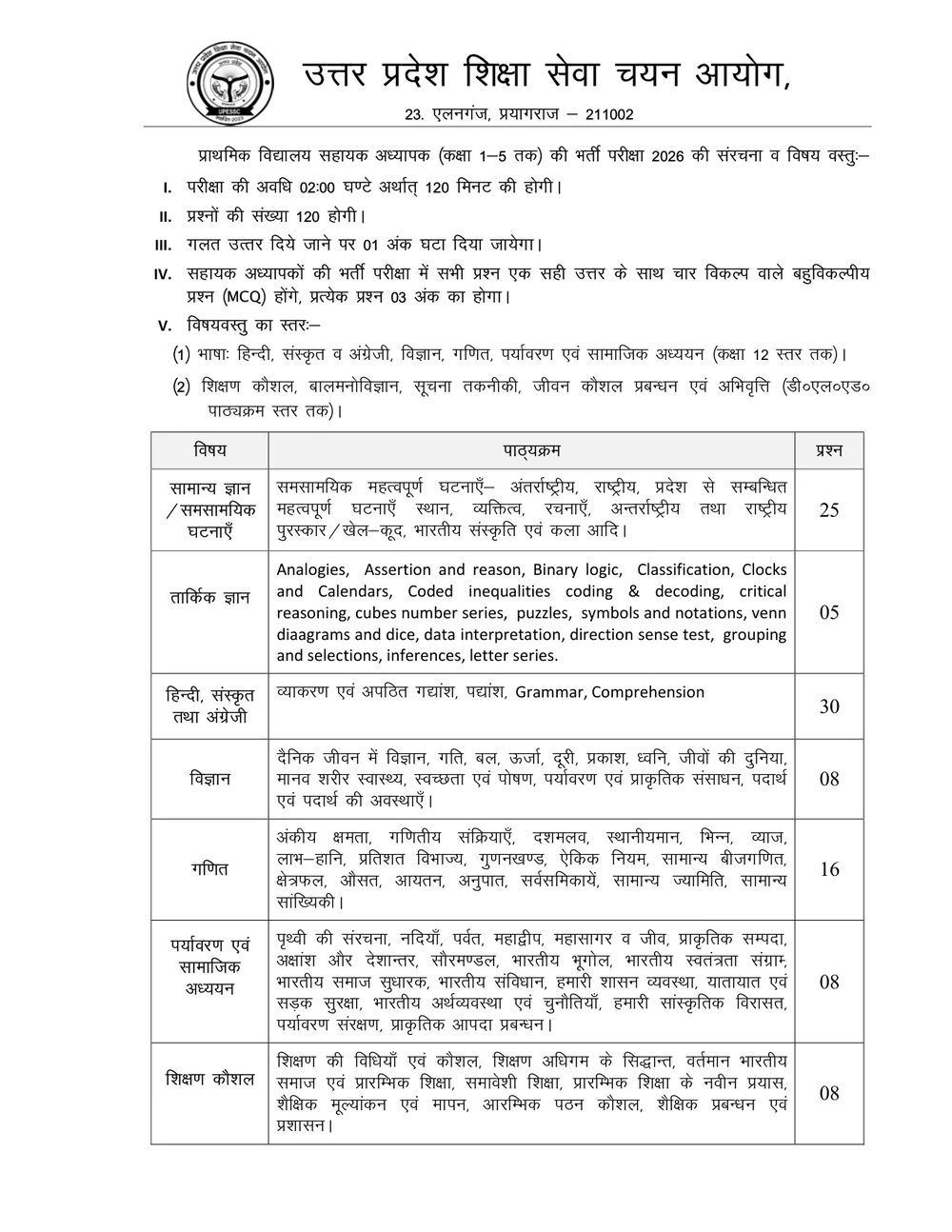
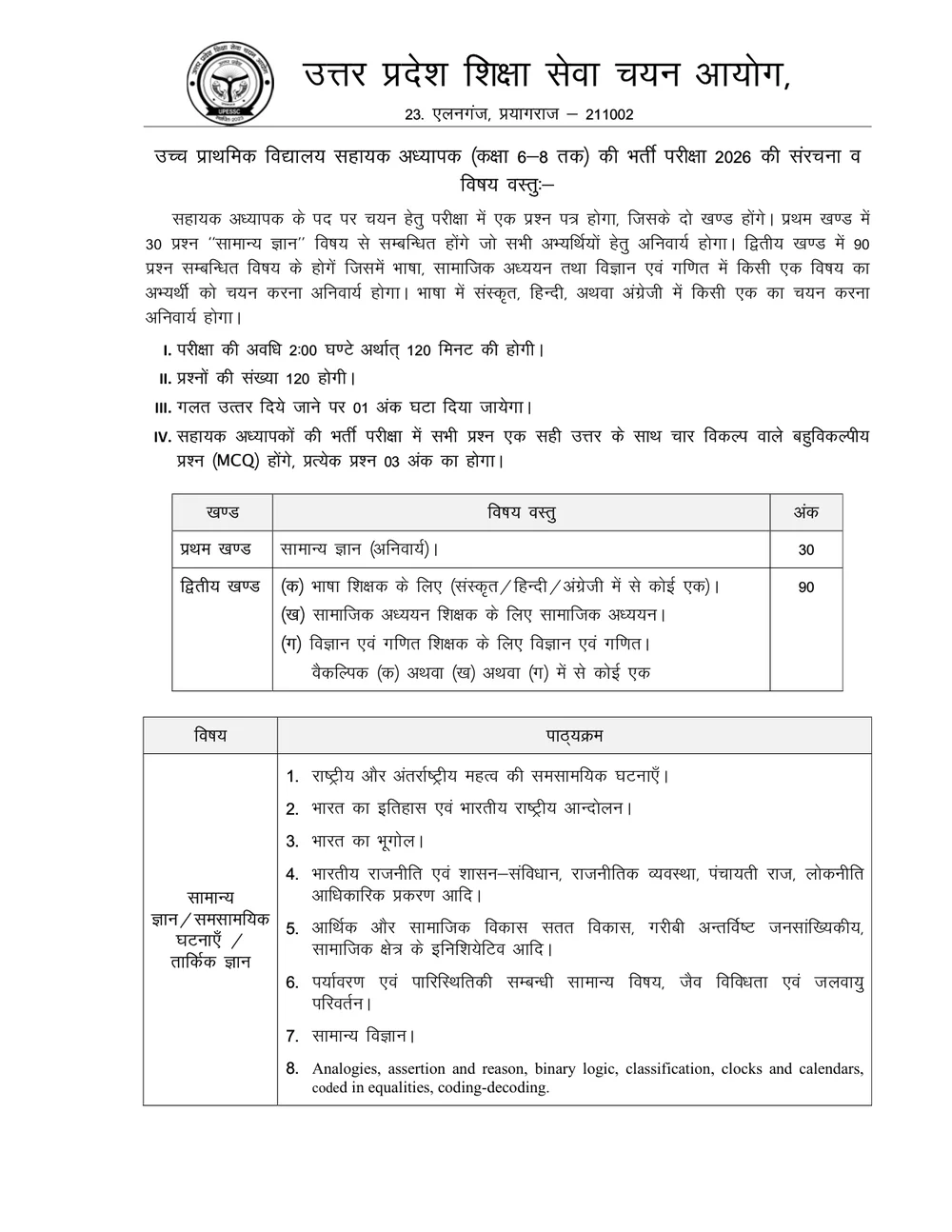
To ensure absolute authenticity and prevent confusion from outdated coaching notes, we provide high-resolution visual previews rendered directly from the official UPESSC 2026 examination documents. You can inspect the structural layout and download the complete PDF files below:
7. Syllabus Level and Difficulty Standards
One of the most frequent misconceptions among candidates is preparing topics at the wrong academic depth. The official 2026 UPESSC notification explicitly defines the difficulty standards for each component:
Applies to academic disciplines in the Primary exam:
- Languages: Hindi, Sanskrit & English (Grammar and syntax)
- Science (Physics, Chemistry, and Biological principles)
- Mathematics (Arithmetic, basic algebra, mensuration)
- Environment & Social Studies (Geography, history, polity)
Applies to professional teacher training disciplines:
- Teaching Skills (Methods of teaching, educational governance)
- Child Psychology (Developmental theories, learning psychology)
- Information Technology (Educational applications, OER)
- Life Skills, Management & Attitude (Professional ethics)
For Junior Teachers, the subject specialization (Section 2) questions reflect the academic depth of University Graduation (Bachelor's Degree) curricula in the respective subject.
8. How to Use the Syllabus for Preparation (8 Actionable Steps)
Treat the syllabus not merely as an informative outline, but as your central preparation checklist. Follow this 8-step framework to maximize your study efficiency:
- Step 1 — Select your teacher category: Decide whether you are competing for Primary Teacher (10 general subjects) or Junior Teacher (compulsory GK plus specialized graduation subject).
- Step 2 — Download & print the official PDF: Keep physical copies of the official syllabus on your study desk to avoid relying on unverified internet claims.
- Step 3 — Build a topic checklist: Break down each domain into specific subtopics and mark each with status tags: Not Started, Studying, Revised, and Practiced.
- Step 4 — Prioritize based on question weightage: Allocate the largest blocks of time to high-yield sections: Languages (30 Qs), GK/Current Affairs (25 Qs), and Mathematics (16 Qs).
- Step 5 — Master core concepts: Focus on understanding fundamental principles rather than memorizing standalone one-liners.
- Step 6 — Solve authentic previous papers: Test your understanding by solving the official 68,500 and 69,000 question papers from our Previous Papers Archive.
- Step 7 — Take timed mock tests: Practice within the strict 120-minute limit on our Mock Test Simulator to master negative marking control (-1 penalty).
- Step 8 — Maintain an error notebook: Document recurring mistakes, tricky mathematical formulas, and pedagogy definitions for rapid weekly revision.
9. Syllabus-Based Study Strategy & Daily Routine
A high-scoring strategy requires balancing broad academic disciplines with specialized pedagogy. Dividing your preparation across three structured daily study blocks prevents mental fatigue while ensuring balanced coverage:
Dedicate morning hours to Mathematics (16 Qs) and Reasoning (5 Qs). Solve numerical problems and logical sets when focus is at its peak.
Rotate between Hindi, English, and Sanskrit grammar and reading passages, followed by Science and Environment & Social Studies chapters.
Study Teaching Skills, Child Psychology, IT (4 Qs), Life Skills, and daily Current Affairs updates. Spend the last 30 minutes revising flashcards.
For a complete 90-day day-by-day roadmap, consult our comprehensive Super TET Preparation Strategy.
10. Previous Year Question Papers & Authentic Practice
While the 2026 examination introduces a 120-question, 360-mark structure with negative marking, historical question papers remain the single most valuable resource for understanding question phrasing, concept difficulty, and factual depth.
Access authentic solved PDFs from the previous recruitment cycles on our dedicated archives:
11. Important Practice Questions & High-Priority MCQs
Rather than relying on misleading "100% guaranteed questions" claims, candidates should focus on high-yield conceptual themes that consistently recur across teacher recruitment tests. Our editorial team has compiled subject-wise objective question banks accompanied by detailed explanatory solutions.
12. Mock Tests & Managing Negative Marking
With 120 questions to be solved in 120 minutes, candidates have exactly 60 seconds per question. Under the +3 / -1 marking scheme, blind guessing can severely damage your merit ranking. Regular simulation tests train your ability to identify high-confidence questions, skip risky doubts, and manage time across numerical and linguistic sections.
13. Common Syllabus Mistakes Candidates Make
Avoid these 10 frequent strategic errors that undermine teacher recruitment preparation:
Preparing for 150 questions without recognizing the official 120-question, 360-mark blueprint.
Relying on social media summaries rather than the verified commission document.
Assuming qualifying eligibility syllabi equal competitive recruitment examination criteria.
Preparing generalized primary pedagogy for degree-level Junior subject specializations.
Skipping IT (4 Qs / 12 marks) or Reasoning (5 Qs / 15 marks), which often decide final cutoff margins.
Practicing blind elimination without accounting for the -1 mark penalty per mistake.
Reading graduate-level higher physics or pure mathematics for Primary Class 12-level subjects.
Reading theory continuously without verifying real question patterns from 68,500 and 69,000.
Focusing solely on completing new chapters while forgetting previously memorized pedagogy theories.
Neglecting standard SCERT/NCERT primary and secondary textbooks in favor of brief coaching summaries.
14. Historical Examination Evolution (68,500 & 69,000)
Understanding how Uttar Pradesh teacher recruitment examinations have evolved helps contextualize historical materials against current requirements:
- 68,500 Assistant Teacher Recruitment (2018): Administered by the Examination Regulatory Authority (ERA / PNP, Prayagraj) as a subjective written examination where candidates wrote brief descriptive answers.
- 69,000 Assistant Teacher Recruitment (2019): Administered as an objective OMR examination featuring 150 multiple-choice questions (1 mark each, 150 minutes duration) with NO negative marking.
- 2026 Unified Recruitment (UPESSC): Restructured by the Uttar Pradesh Education Service Selection Commission into a 120-question, 360-mark examination (+3 for correct, -1 for incorrect) with a 120-minute time duration.
Note: Past question papers from 2018 and 2019 are valuable for topic comprehension, but their exam structures (150 questions / no negative marking) do not apply to the 2026 recruitment cycle.