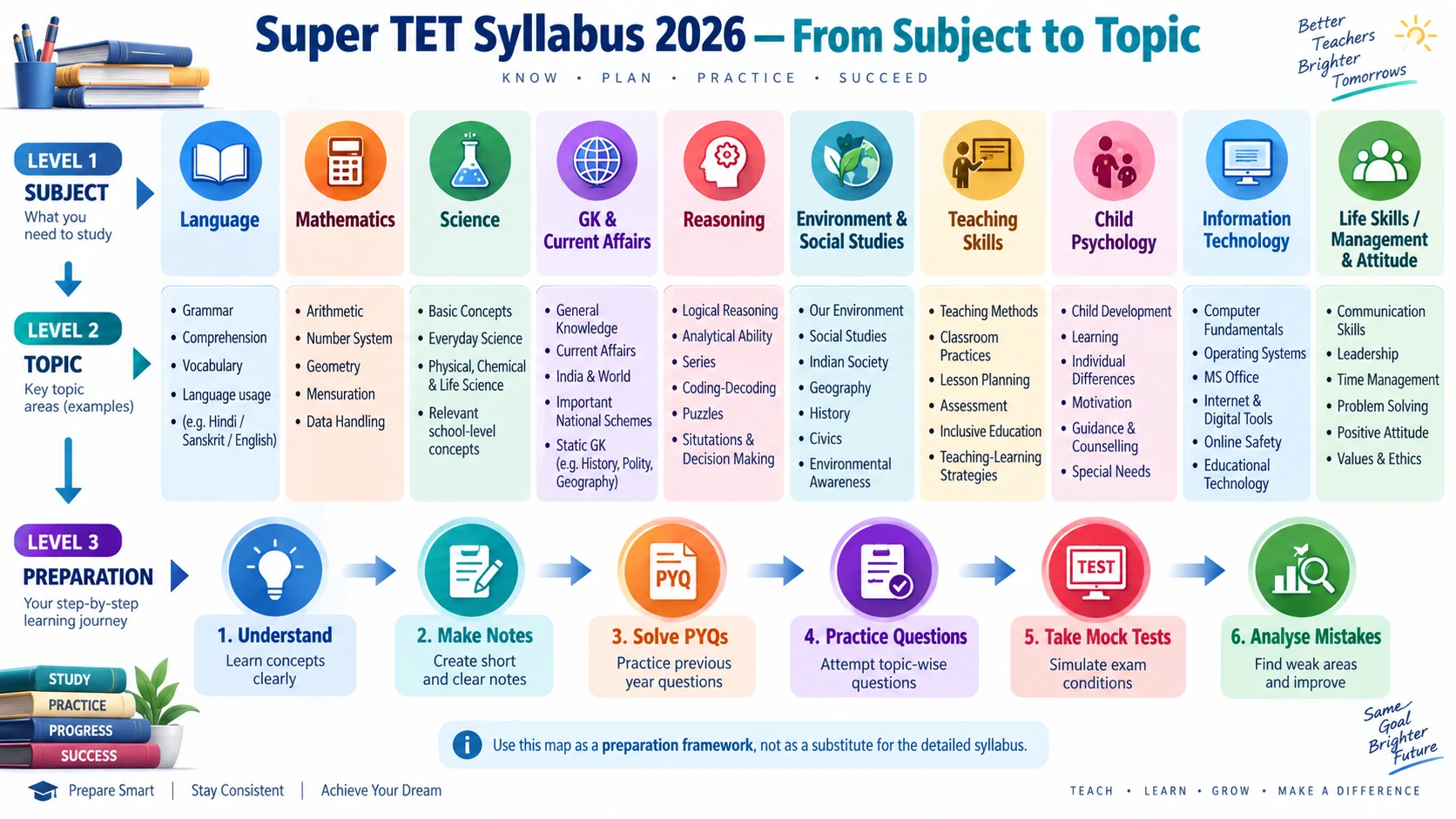
Classes 1–5 Examination Blueprint

Super TET 2026 Primary Teacher Syllabus

This page presents the official Super TET 2026 Primary Teacher (Classes 1–5) syllabus structure based on the supplied Uttar Pradesh teacher recruitment examination documents. Candidates preparing for primary school Assistant Teacher recruitment can review the complete 10-subject curriculum, question distribution, academic standard levels, and preparation guidance.

Quick Overview: Super TET 2026 Primary Teacher Exam

Teaching Level
Classes 1–5
Primary School Assistant Teacher
Total Questions
120 Questions
Objective Multiple-Choice Questions (MCQs)
Duration
120 Minutes
2 Hours single continuous session
Maximum Marks
360 Marks
3 marks per question
Marking Scheme
+3 / -1
+3 marks for correct, -1 mark penalty per wrong answer

Note: These examination parameters provide an immediate structural reference. Detailed regulations regarding examination procedures, cut-offs, and qualifying criteria are available on the dedicated Super TET Exam Pattern page.

Subject-Wise Syllabus for Primary Teacher (Classes 1–5)

The Super TET 2026 Primary Teacher recruitment examination covers exactly 10 distinct subject domains as specified in the official examination documents. Review each subject section below for question weightage and curricular scope.

A. General Knowledge / Current Affairs

25 Questions (75 Marks)

Covers national and international current affairs, contemporary events, Uttar Pradesh state-specific general knowledge, historical developments, geographical facts, Indian polity, culture, scientific advancements, awards, and sports.

Use the applicable 2026 syllabus document for the detailed topic-level scope.

B. Reasoning Ability

5 Questions (15 Marks)

Evaluates logical, verbal, and non-verbal analytical reasoning, including analogies, classification, series completion, coding-decoding, blood relations, direction sense, and critical logic deductions.

Use the applicable 2026 syllabus document for the detailed topic-level scope.

C. Language: Hindi / Sanskrit / English

30 Questions (90 Marks)

Encompasses language comprehension, unseen prose and poetry passages, grammar, vocabulary, word formation, idioms and phrases, sentence structure, and linguistic mechanics across Hindi, Sanskrit, and English.

Use the applicable 2026 syllabus document for the detailed topic-level scope.

D. Science

8 Questions (24 Marks)

Fundamental principles of physics, chemistry, and biology, including daily life applications of science, states of matter, speed, force, energy, light, sound, human body systems, health and hygiene, and nutrition.

Use the applicable 2026 syllabus document for the detailed topic-level scope.

E. Mathematics

16 Questions (48 Marks)

Numerical ability, basic mathematical operations, fractions, decimals, percentages, profit and loss, simple and compound interest, averages, ratio and proportion, basic algebra, geometry, perimeter, area, and volume.

Use the applicable 2026 syllabus document for the detailed topic-level scope.

F. Environment & Social Studies

8 Questions (24 Marks)

Earth's structure, rivers, mountains, continents, oceans, natural resources, flora and fauna, environmental conservation, Indian constitution and governance, civic rights, and administrative systems.

Use the applicable 2026 syllabus document for the detailed topic-level scope.

G. Teaching Skills

8 Questions (24 Marks)

Teaching methods and strategies, principles of effective learning, educational assessment and evaluation techniques, inclusive teaching frameworks, classroom management, and primary educational initiatives.

Use the applicable 2026 syllabus document for the detailed topic-level scope.

H. Child Psychology

8 Questions (24 Marks)

Factors influencing child growth and development, individual learner variations, creation of conducive learning environments, theories of learning, and practical psychological approaches in elementary classrooms.

Use the applicable 2026 syllabus document for the detailed topic-level scope.

I. Information Technology

4 Questions (12 Marks)

Basic computer operations, fundamentals of internet, digital educational applications, smart classroom technologies, open educational resources (OER), and basic hardware/software awareness in education.

Use the applicable 2026 syllabus document for the detailed topic-level scope.

J. Life Skills / Management & Attitude

8 Questions (24 Marks)

Professional conduct, teacher ethics, motivation strategies, administrative values, constitutional values, penalty and reward structures, and professional accountability in primary school leadership.

Use the applicable 2026 syllabus document for the detailed topic-level scope.

Standard & Academic Rigor Levels

As specified in the official 2026 teacher recruitment syllabus document, the examination evaluates candidates across two distinct standards of difficulty depending on the nature of the subject area:

Class 12 Standard Academic Subjects

Questions in foundational school subject disciplines are framed up to the Class 12 (Intermediate) standard:

  • Hindi / Sanskrit / English (Languages) — 30 Questions
  • Science — 8 Questions
  • Mathematics — 16 Questions
  • Environment & Social Studies — 8 Questions
Preparation recommendation: Study foundational NCERT and SCERT textbooks from Class 6 through Class 12 for strong conceptual clarity.
D.El.Ed Standard Professional & Pedagogy Areas

Questions in professional, instructional, and pedagogical domains are framed up to the D.El.Ed (Diploma in Elementary Education) standard:

  • Teaching Skills — 8 Questions
  • Child Psychology — 8 Questions
  • Information Technology — 4 Questions
  • Life Skills / Management & Attitude — 8 Questions
Preparation recommendation: Review core D.El.Ed / BTC teacher training course materials, child development modules, and classroom pedagogy textbooks.

Super TET 2026 Primary Teacher Question Distribution

The table below displays the official subject distribution for all 120 questions across the 10 examination categories. Each question carries 3 marks, making the total examination worth 360 marks.

Subject Questions
General Knowledge / Current Affairs 25
Reasoning Ability 5
Language (Hindi / Sanskrit / English) 30
Science 8
Mathematics 16
Environment & Social Studies 8
Teaching Skills 8
Child Psychology 8
Information Technology 4
Life Skills / Management & Attitude 8
TOTAL 120

How to Use This Syllabus for Preparation

Effective preparation for the Super TET Primary Teacher examination requires structured planning aligned with official question allocations and standard specifications. Follow these practical steps:

1 Make a Subject Checklist

Catalog all 10 subjects into a personal tracking checklist to monitor conceptual coverage and revision schedules systematically.

2 Prioritize High-Question Subjects

Allocate adequate daily study hours to the highest-weightage disciplines: Languages (30 questions), General Knowledge & Current Affairs (25 questions), and Mathematics (16 questions), which together comprise 71 of the 120 questions.

3 Study Academic Subjects at Stated Level

Study Hindi, Sanskrit, English, Science, Mathematics, and Environment & Social Studies up to Class 12 standard using standard secondary and senior secondary school textbooks.

4 Separately Prepare Education Subjects

Dedicate distinct preparation time for Teaching Skills, Child Psychology, Information Technology, and Life Skills based on the D.El.Ed curriculum and pedagogy theories.

5 Use Previous Papers for Style Insights

Solve historical question papers (such as 68,500 and 69,000 assistant teacher recruitment tests) to familiarize yourself with language framing, phrasing, and difficulty trends.

6 Practice Timed Mock Tests

Once full syllabus coverage is attained, attempt full-length timed mock exams to optimize speed, time allocation (120 minutes for 120 questions), and negative marking discipline (+3 / -1).

Frequently Asked Questions (FAQ)

Clear, direct answers to common questions about the Super TET 2026 Primary Teacher syllabus, question distribution, and standards:

What is the Primary Teacher syllabus for Super TET 2026?
The Super TET 2026 Primary Teacher syllabus covers 10 subject areas: General Knowledge / Current Affairs, Reasoning Ability, Languages (Hindi, Sanskrit, English), Science, Mathematics, Environment & Social Studies, Teaching Skills, Child Psychology, Information Technology, and Life Skills / Management & Attitude.
Which classes does the Primary Teacher post cover?
The Primary Teacher (Assistant Teacher) recruitment examination is conducted specifically for teaching appointments in Classes 1 to 5 in primary schools across Uttar Pradesh.
How many questions are in the Primary Teacher examination?
There are exactly 120 objective multiple-choice questions in the Super TET 2026 Primary Teacher examination, carrying a total of 360 marks with an exam duration of 120 minutes.
Which subject has the highest number of questions?
Languages (Hindi, Sanskrit, English combined) carries the highest question allocation with 30 questions, followed closely by General Knowledge & Current Affairs with 25 questions and Mathematics with 16 questions.
What is the level of Science and Mathematics in the 2026 syllabus?
In the official 2026 syllabus document, academic subjects including Science, Mathematics, Environment & Social Studies, and Languages are specified up to the Class 12 (Intermediate) standard.
What is the level of Teaching Skills and Child Psychology?
Professional and pedagogical areas including Teaching Skills, Child Psychology, Information Technology, and Life Skills / Management & Attitude are prescribed up to the D.El.Ed (Diploma in Elementary Education) standard.
Is Hindi/Sanskrit/English included in the Primary Teacher syllabus?
Yes, Language (encompassing Hindi, Sanskrit, and English) is a mandatory composite subject in the Primary Teacher syllabus with a combined total of 30 questions.
How should I prepare from the syllabus?
Create a subject checklist, prioritize high-weightage sections (Languages, GK/Current Affairs, and Mathematics), study academic subjects up to Class 12 standard and pedagogy up to D.El.Ed standard, analyze previous examination papers to observe question style, and practice timed mock tests to manage the +3 / -1 negative marking system.