Aspirant Action Guide

Super TET Preparation Strategy 2026

Preparing for the Uttar Pradesh Super TET examination requires structured concept building, rigorous practice, and calculated time management. With the 2026 format enforcing 120 questions across 120 minutes and a +3/-1 marking rule, success depends on deliberate, systematic study habits rather than arbitrary cramming.

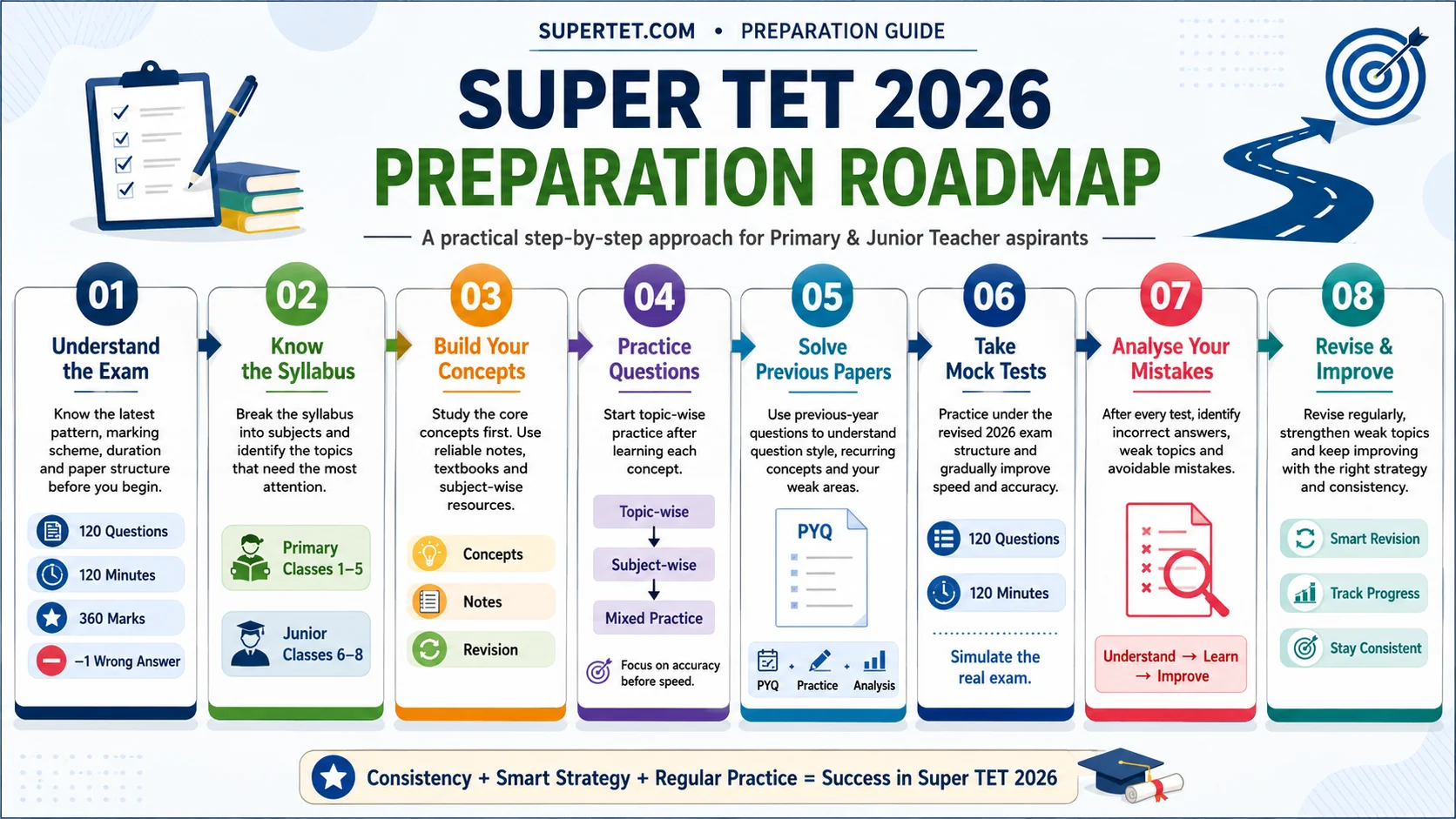
Super TET 2026 preparation roadmap covering syllabus, practice, previous papers, mock tests and revision
Five-stage Super TET preparation roadmap: Syllabus completion → Concept building → MCQ practice → Mock tests → Revision.

1. Quick-Start Preparation Framework

Aspirants beginning their preparation journey should initiate their workflow through four structured preliminary steps:

Step 1: Download Official Syllabus

Review every listed topic for your target cadre (Primary or Junior) before purchasing textbooks.

Step 2: Solve a Diagnostic Paper

Attempt an authentic past paper to identify baseline strengths, blind spots, and timing constraints.

Step 3: Establish a Daily Routine

Set dedicated daily hours that you can maintain consistently, balancing theory study with question practice.

Step 4: Maintain an Error Log

Keep a dedicated notebook to record questions missed during daily practice and note underlying concepts.

2. Understand the Exam Pattern (Primary vs Junior)

Your study plan must strictly align with the examination framework of your specific cadre:

Primary Teacher (Classes 1–5)

  • 120 questions across 10 subject areas.
  • Languages (30 Qs / 90 Marks) and GK (25 Qs / 75 Marks) form nearly half the paper.
  • Demands broad multi-disciplinary proficiency across academic and pedagogical subjects.
  • Read the full Primary Teacher Exam Pattern →

Junior Teacher (Classes 6–8)

  • Section 1: 30 compulsory General Knowledge questions (90 Marks).
  • Section 2: 90 questions (270 Marks) from one selected pathway (Language, Social Studies, or Science & Math).
  • Demands concentrated deep mastery in your graduate teaching specialization.
  • Read the full Junior Teacher Exam Pattern →

3. Complete the Syllabus Systematically

Avoid jumping randomly between topics. Break each prescribed subject into concrete learning units and track your progress chapter by chapter:

  • Audit the syllabus: Print or reference the Super TET Syllabus and check off topics only after completing both notes and practice MCQs.
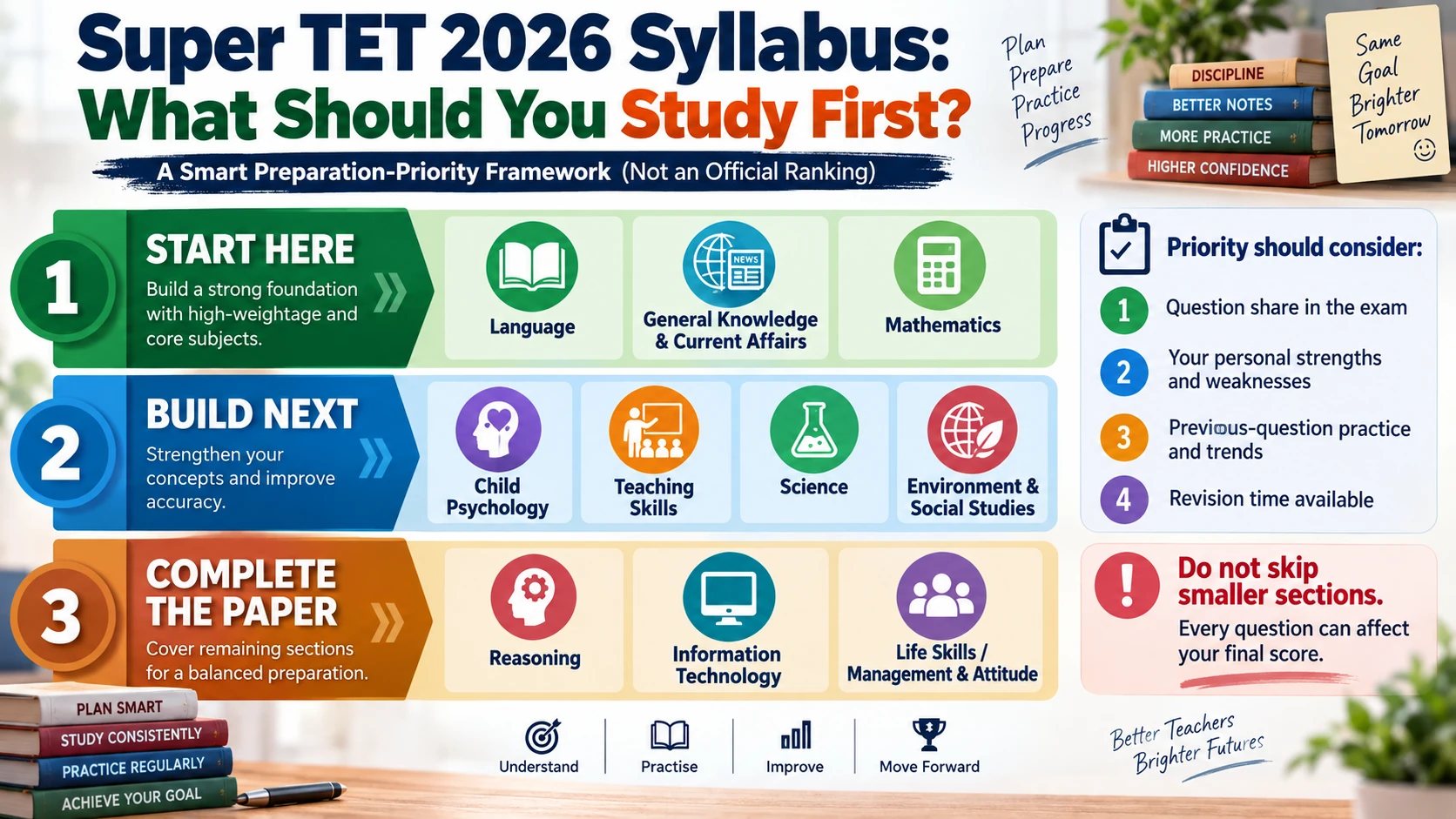
  • Group related subjects: Study complementary subjects together (e.g., Child Psychology and Teaching Skills, or Science and Environment).
  • Prioritize high-question domains: Dedicate proportionally more study slots to subjects with the largest question allocations.

4. Build Subject-Wise Concepts

Rote memorization often fails when questions assess applied comprehension. Build foundational understanding using standard academic references:

  • Academic Subjects (Math, Science, Social Studies): Refer to UP State Board / SCERT textbooks from Class 6 to 10 for conceptual clarity.
  • Pedagogy (Teaching Skills & Child Psychology): Use standard D.El.Ed / B.Ed training manuals to understand developmental stages, learning theories, and teaching methods.
  • Languages: Emphasize grammatical rules, reading comprehension passages, and vocabulary rather than guessing rules.
  • Current Affairs & GK: Follow daily news summaries and monthly current affairs compendiums with dedicated attention to Uttar Pradesh state initiatives.

5. Practice MCQs with Negative Marking Discipline

The 2026 exam enforces a +3 mark award for correct responses and a -1 mark deduction for incorrect responses:

  • Solve questions in timed batches (e.g., 30 questions in 30 minutes) using our Practice MCQs.
  • Practice option elimination: rule out obviously incorrect options before choosing your final answer.
  • Learn to skip: leaving a doubtful question unattempted preserves your existing score with zero penalty.

6. Solve Previous Year Question Papers

Authentic previous examination papers reflect actual question formulation styles, difficulty standards, and recurring thematic areas:

Download and attempt authentic papers from earlier recruitment cycles via our Previous Year Papers Repository →. Solve them under strict 120-minute exam conditions.

7. Take Mock Tests & 8. Analyse Mistakes

Full-Length Mock Testing

Attempt full 120-question, 120-minute simulations periodically on our Free Mock Tests → portal to test physical endurance, pacing, and section transition speed.

Post-Test Error Analysis

Spend at least as much time reviewing a mock test as taking it. Classify mistakes into conceptual gaps, misreading questions, or rash guesswork to prevent repeating errors.

9. Revision Strategy (Spaced Repetition)

Without structured revision, retention decays rapidly across a 10-subject syllabus. Employ spaced review cycles:

  • Daily Micro-Revision (30 mins): Review yesterday's notes before starting new chapters.
  • Weekly Consolidation: Reserve one day each week exclusively for reviewing error logs, formulas, and vocabulary.
  • Short Fact Sheets: Create one-page summary sheets for quick-recall facts (dates, teaching maxims, mathematical formulas).

10. Final-Week Preparation & 11. Exam-Day Approach

Final 7 Days Protocol

  • Stop studying entirely new topics.
  • Review your personal error notebook and key formula sheets.
  • Consolidate UP Current Affairs from the past 6 months.
  • Ensure regular sleep patterns matching exam morning hours.

Exam-Day Strategy (3-Pass Method)

  • Round 1 (Minutes 0–60): Answer direct, high-confidence questions immediately.
  • Round 2 (Minutes 60–100): Solve calculation-intensive and moderate difficulty questions.
  • Round 3 (Minutes 100–120): Review flagged questions; avoid guessing on doubtful items.

12. Common Preparation Mistakes to Avoid

  • Ignoring negative marking: Wildly attempting all 120 questions can severely depress your net score due to -1 penalties.
  • Neglecting low-weight subjects: Skipping IT (4 Qs) or Reasoning (5 Qs) unnecessarily forfeits straightforward marks.
  • Collecting excess materials: Studying 5 different books for the same subject leads to confusion; master 1 reliable source thoroughly.
  • Passive reading without timed MCQs: Reading theory without timed practice creates false confidence that crumbles under real test pressure.

13. Related Super TET 2026 Resources

Super TET Syllabus →
Complete curriculum details for primary and upper primary cadres.
Exam Pattern Guide →
Master breakdown of duration, marks, and question allocations.
Study Plan 2026 →
Structured 90-day timetable, daily routines, and revision milestones.
Study Material & Notes →
Subject-wise foundational notes and pedagogical references.
Previous Year Papers →
Official past question papers with verified answer keys.
Free Mock Tests →
Timed test series with real-time scoring and negative marking.
Important MCQs →
Chapter-wise practice questions with step-by-step explanations.