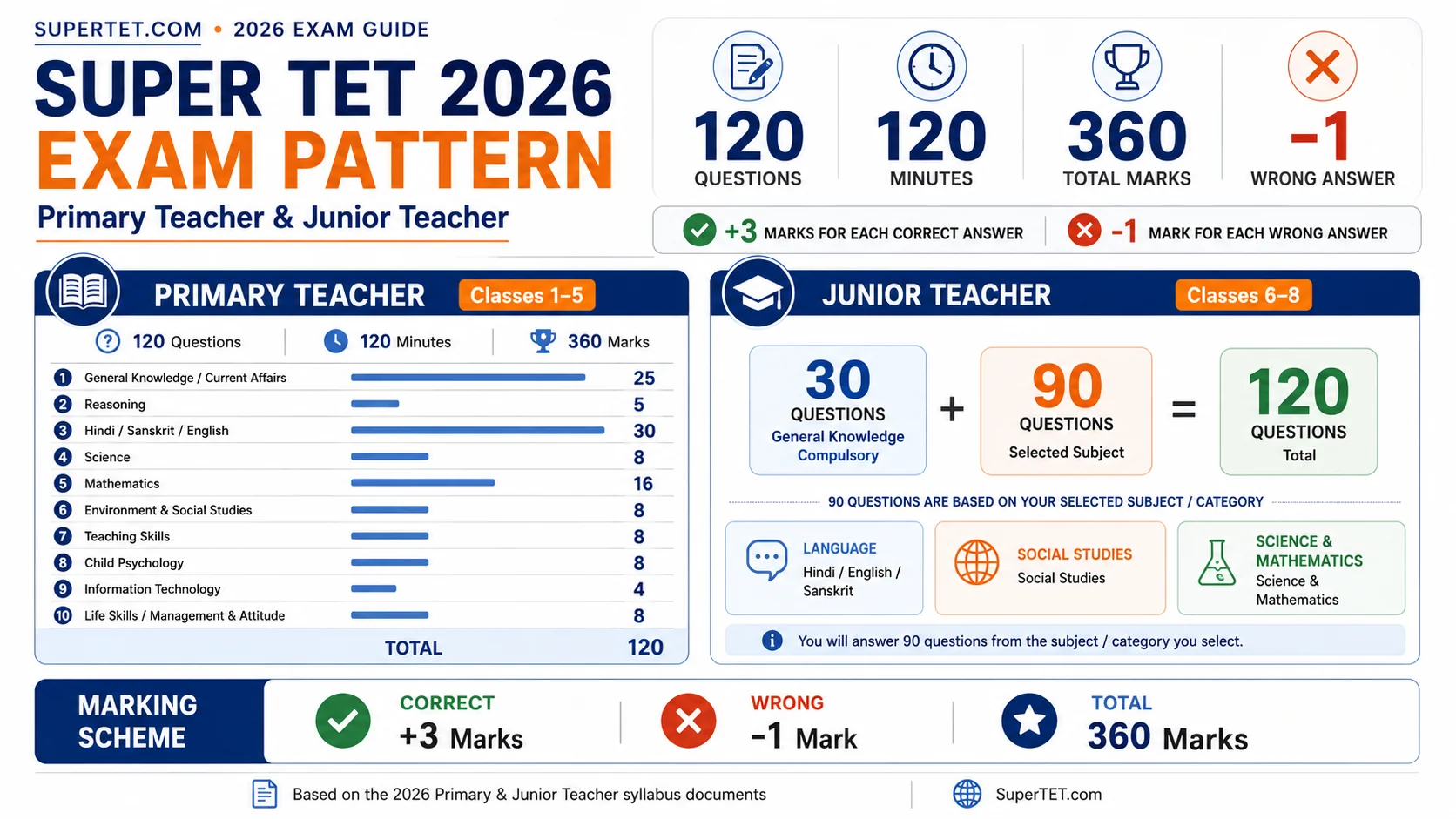
Compare key examination parameters and section structures between Primary and Junior cadres.
Parameter
Primary Teacher (Classes 1–5)
Junior Teacher (Classes 6–8)
Teaching level
Classes 1–5
Classes 6–8
Paper structure
Single paper (10 subjects)
One paper (Section 1 Compulsory GK + Section 2 Selected Subject)
Total questions
120
120
Duration
120 minutes
120 minutes
Maximum marks
360
360
General Knowledge
25 questions (75 marks)
30 compulsory questions in Section 1 (90 marks)
Subject section
95 questions across 9 subjects
90 questions from selected teaching subject in Section 2 (270 marks)
Negative marking
-1 for each wrong answer
Question paper language
Hindi + English
Hindi + English
How to Read the Pattern
1
Identify High-Question-Weight Subjects:
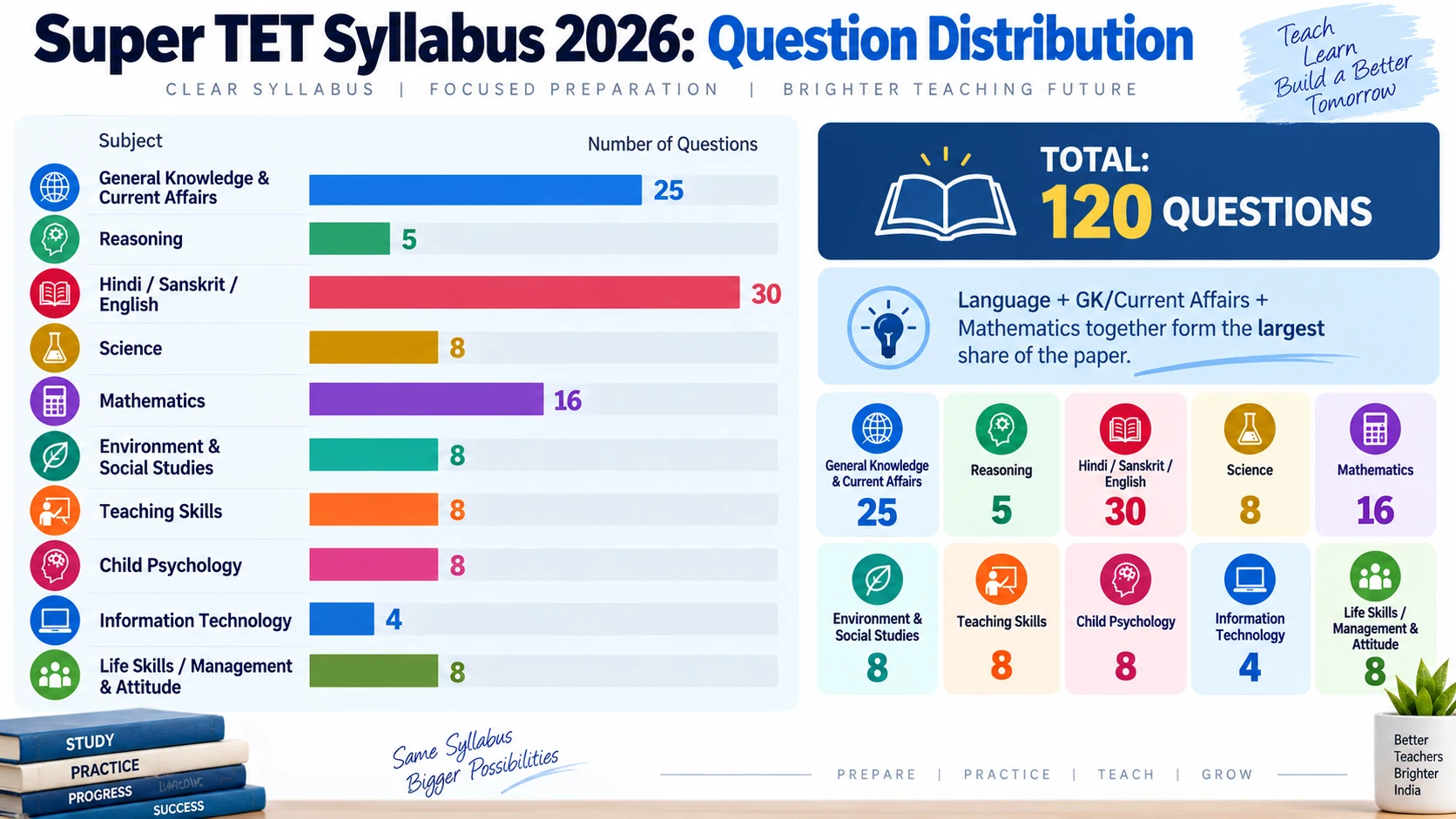
In Primary, Hindi/Sanskrit/English (30 questions) and General Knowledge / Current Affairs (25 questions) constitute 55 of 120 questions. In Junior, Section 2 carries 90 questions (75% of the total paper). Prioritizing high-weight areas ensures maximum return on preparation time.
2
Understand the Primary Distribution:
The 10 Primary subjects include foundational disciplines (Languages, Mathematics, Science, EVS) and pedagogical topics (Teaching Skills, Child Psychology, Life Skills/Management, IT). Candidates must allocate structured study across all 10 areas rather than relying solely on traditional academic subjects.
3
Identify the Junior Subject Pathway:
Junior candidates need to master their chosen Section 2 pathway—Language Teacher (Sanskrit, Hindi, or English), Social Studies Teacher, or Science & Mathematics Teacher—while maintaining strong general awareness for the compulsory 30 questions in Section 1.
4
Plan Practice According to Question Distribution:
With 120 questions to be solved in 120 minutes, aspirants have an average of 1 minute per question. Timed mock tests under realistic conditions are essential to build pace, avoid time traps in calculation-heavy sections like Mathematics, and ensure all 120 questions are reviewed.
5
Account for Negative Marking:
Because each incorrect answer deducts 1 mark (+3 / −1 ratio), random guessing incurs a severe statistical penalty. Unattempted questions carry 0 penalty. Aspirants should only guess when they can reliably eliminate at least two options.
Navigation & Prep Hub
Related Super TET 2026 Resources
Verified links to comprehensive guides across SuperTET.com:
Verified answers regarding the Super TET 2026 examination format, questions, duration, and marking scheme.
How many questions are there in Super TET 2026?
There are 120 questions in total in the Super TET 2026 examination for both Primary Teacher (Classes 1–5) and Junior Teacher (Classes 6–8) posts.
What is the duration of Super TET 2026?
The examination duration is 120 minutes (2 hours) for both Primary and Junior cadres, allowing an average of 1 minute per question.
Is there negative marking?
Yes. Under the verified 2026 examination pattern, there is negative marking of −1 mark deducted for each wrong answer. Correct responses earn +3 marks, and unattempted questions receive 0 marks (no penalty).
What is the Primary Teacher exam pattern?
The Primary Teacher examination (Classes 1–5) features 120 multiple choice questions (360 marks) distributed across 10 subjects: General Knowledge / Current Affairs (25), Reasoning (5), Hindi / Sanskrit / English (30), Science (8), Mathematics (16), Environment & Social Studies (8), Teaching Skills (8), Child Psychology (8), Information Technology (4), and Life Skills / Management & Attitude (8).
What is the Junior Teacher exam pattern?
The Junior Teacher examination (Classes 6–8) consists of one paper with 120 questions (360 marks) in two sections: Section 1 has 30 compulsory General Knowledge questions (90 marks), and Section 2 has 90 questions (270 marks) from the candidate's selected subject pathway.
How many questions are in Junior Teacher Section 1?
There are 30 questions (90 marks) in Junior Teacher Section 1. This section covers General Knowledge and is compulsory for all candidates.
How many questions are in Junior Teacher Section 2?
There are 90 questions (270 marks) in Junior Teacher Section 2. Candidates answer questions from one of three pathways: Language Teacher (Sanskrit, Hindi, or English), Social Studies Teacher, or Science & Mathematics Teacher.
What is the maximum mark?
The maximum mark for the Super TET 2026 examination is 360 marks (120 questions × 3 marks per question) for both Primary and Junior cadres.