
Super TET 2026 Primary Teacher Exam Pattern
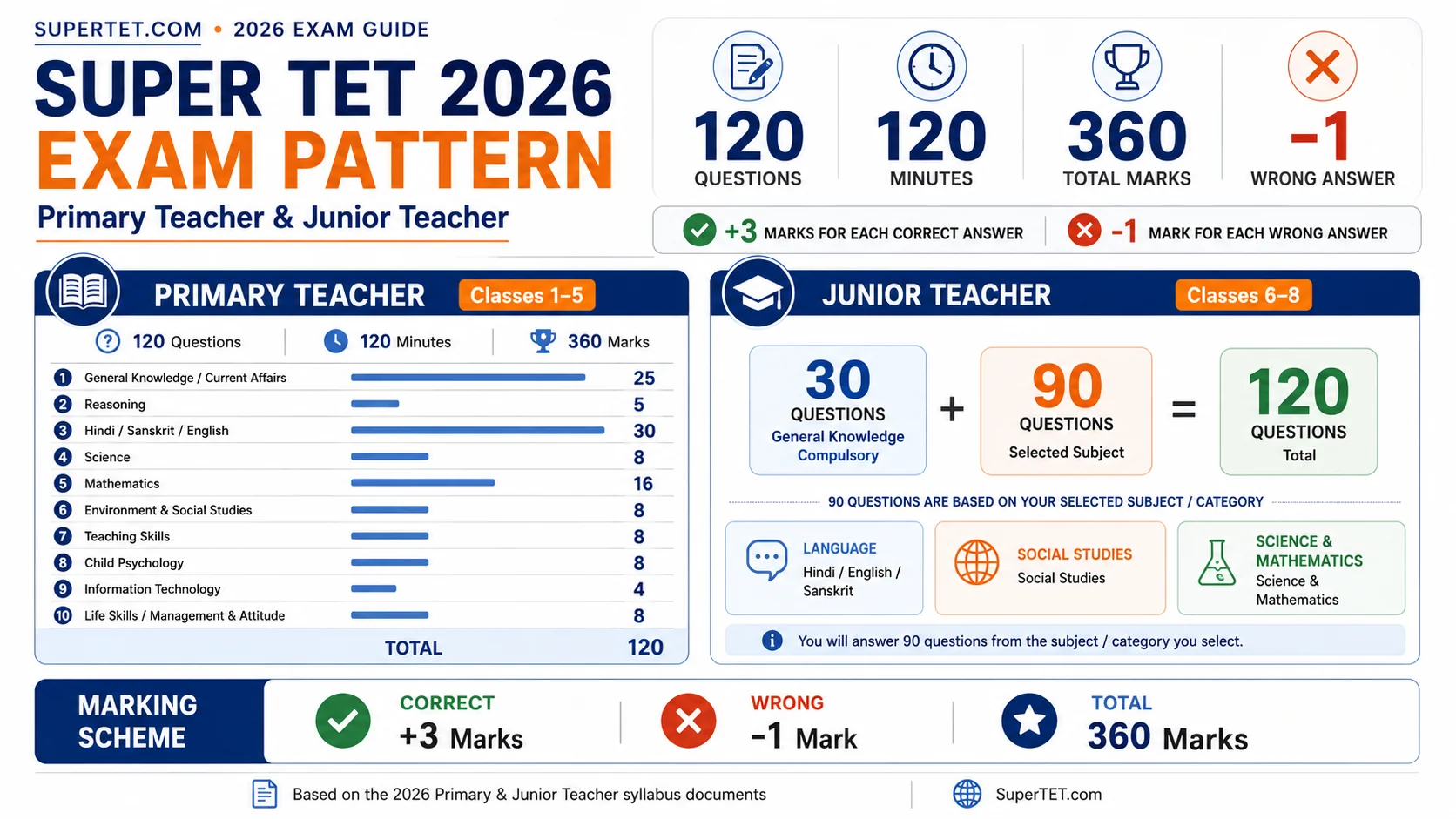
This page outlines the official 2026 Primary Teacher examination structure for Classes 1–5 based on the supplied Uttar Pradesh teacher recruitment examination documents. Candidates preparing for primary school Assistant Teacher recruitment can review the complete 120-question, 360-mark blueprint, subject-wise distribution, negative marking system, and question paper details.
Quick Exam Snapshot
Subject-Wise Exam Pattern & Marks Distribution
The official UPESSC Primary Teacher recruitment exam document specifies 14 individual subjects organized into 10 combined question disciplines comprising 120 questions (360 marks). Each question is worth 3 marks, yielding a total maximum score of 360 marks:
| Subject | Questions | Marks |
|---|---|---|
| General Knowledge / Current Affairs | 25 | 75 |
| Reasoning | 5 | 15 |
| Hindi / Sanskrit / English | 30 | 90 |
| Science | 8 | 24 |
| Mathematics | 16 | 48 |
| Environment & Social Studies | 8 | 24 |
| Teaching Skills | 8 | 24 |
| Child Psychology | 8 | 24 |
| Information Technology | 4 | 12 |
| Life Skills / Management & Attitude | 8 | 24 |
| TOTAL | 120 | 360 |
Marking Scheme & Negative Marking Rules
The Super TET 2026 Primary Teacher examination enforces a strict +3 / -1 marking scheme as specified in the official 2026 examination documents:
For each question answered correctly, 3 marks are awarded to the candidate's score.
For each question answered incorrectly, a penalty of 1 mark is deducted from the total score.
Questions left blank or unattempted receive zero marks, with no penalty deduction.
Calculation Note: Total Score = (Number of Correct Answers × 3) − (Number of Incorrect Answers × 1).
Question Paper Details
- Total Questions: 120 objective questions spanning all 10 prescribed subject areas.
- Format: Multiple-Choice Questions (MCQ format).
- Options: Exactly 4 options (A, B, C, D) per question.
- Correct Answer: Exactly one single correct option per question.
- Language Medium: Bilingual question paper in Hindi and English (language sections appear in the respective language).
- Session Mode: Single continuous paper conducted over 120 minutes (2 hours).
Weightage Overview & Subject Analysis
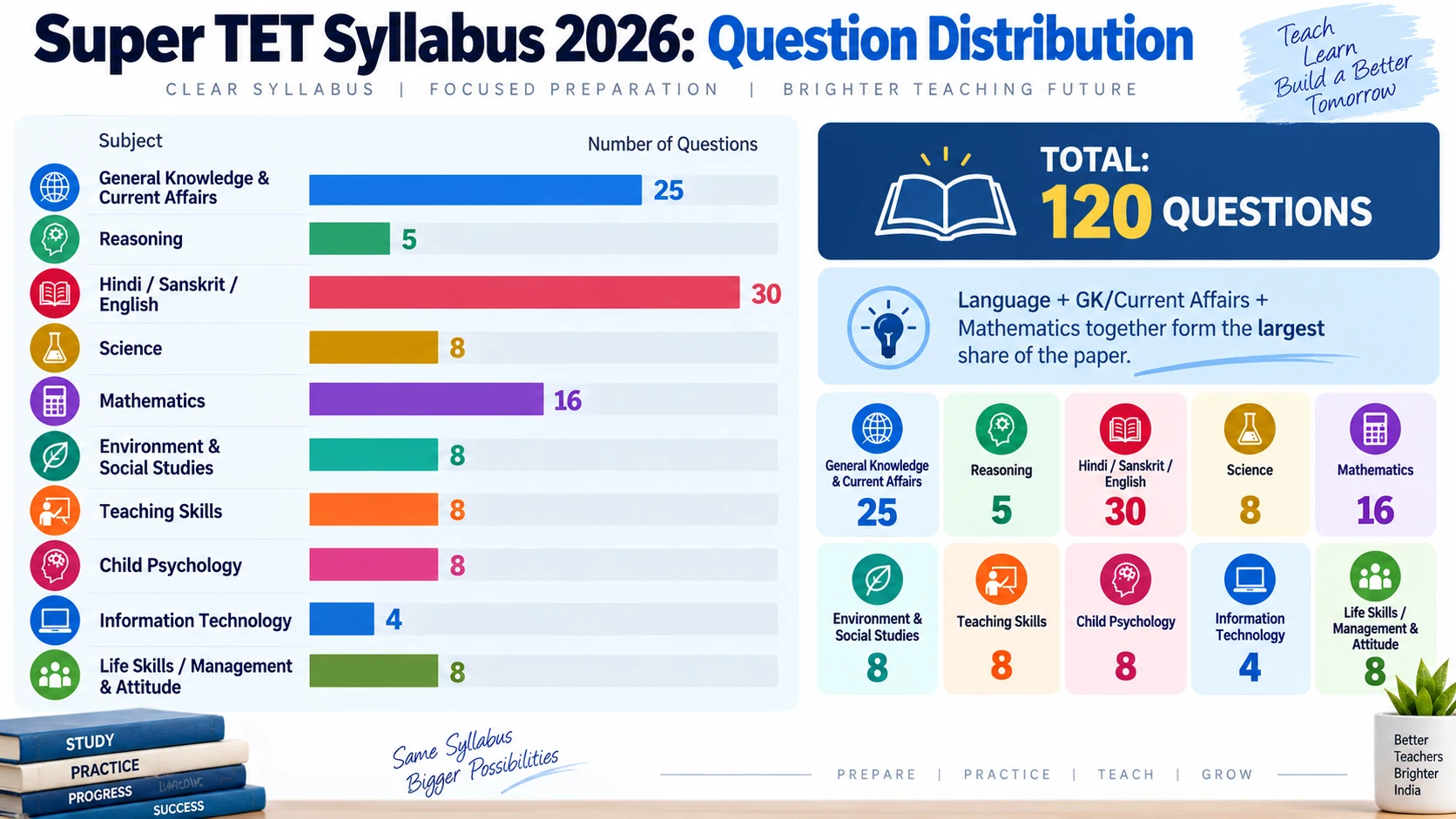
Based on the official question distribution, the 10 combined subject groups exhibit distinct question allocations that guide strategic study scheduling:
Hindi / Sanskrit / English
Carries the largest single allocation with 30 questions (90 marks) across language comprehension and grammar.
General Knowledge / Current Affairs
Carries the second largest allocation with 25 questions (75 marks) covering national, international, and UP state awareness.
Mathematics
Allocated 16 questions (48 marks) evaluating arithmetic, numerical aptitude, algebra, and geometry.
The remaining 49 questions are distributed across: Science (8 questions), Environment & Social Studies (8 questions), Teaching Skills (8 questions), Child Psychology (8 questions), Life Skills / Management & Attitude (8 questions), Reasoning (5 questions), and Information Technology (4 questions).
How to Use the Primary Teacher Exam Pattern
Candidates can directly leverage the official question distribution and marking rules to structure effective exam preparation:
Distribute your weekly study hours to match question volumes, giving substantial focus to Languages, GK, and Mathematics.
Ensure mastery over Language (30 Qs), GK / Current Affairs (25 Qs), and Mathematics (16 Qs), which together represent 71 of the 120 questions.
Maintain balanced preparation between secondary school academic subjects (Class 12 standard) and teacher training pedagogy (D.El.Ed standard).
Simulate full 120-minute exam runs to practice pace management, aiming for approximately 1 minute per question.
Develop discipline against wild guessing; losing 1 mark for an error can quickly erode gains earned by 3-mark correct answers.
Frequently Asked Questions (FAQ)
Direct, verified answers to common questions regarding the Super TET 2026 Primary Teacher exam pattern: