
Comparative Examination Guide

Super TET 2026: Primary vs Junior Teacher

The Uttar Pradesh teacher recruitment framework differentiates recruitment for primary school teachers (Classes 1–5) and junior high school teachers (Classes 6–8). While both examinations share an identical 120-question, 120-minute, 360-mark scale with +3/-1 marking, their question division and subject specialization pathways differ significantly.

Direct Pattern Comparison: Primary vs Junior Teacher

Feature Primary Teacher Junior Teacher
Classes 1–5 6–8
Questions 120 120
Duration 120 minutes 120 minutes
Maximum Marks 360 360
Correct Answer +3 +3
Wrong Answer -1 -1
Structure Subject-wise paper (10 subjects) GK + selected subject (2 sections)
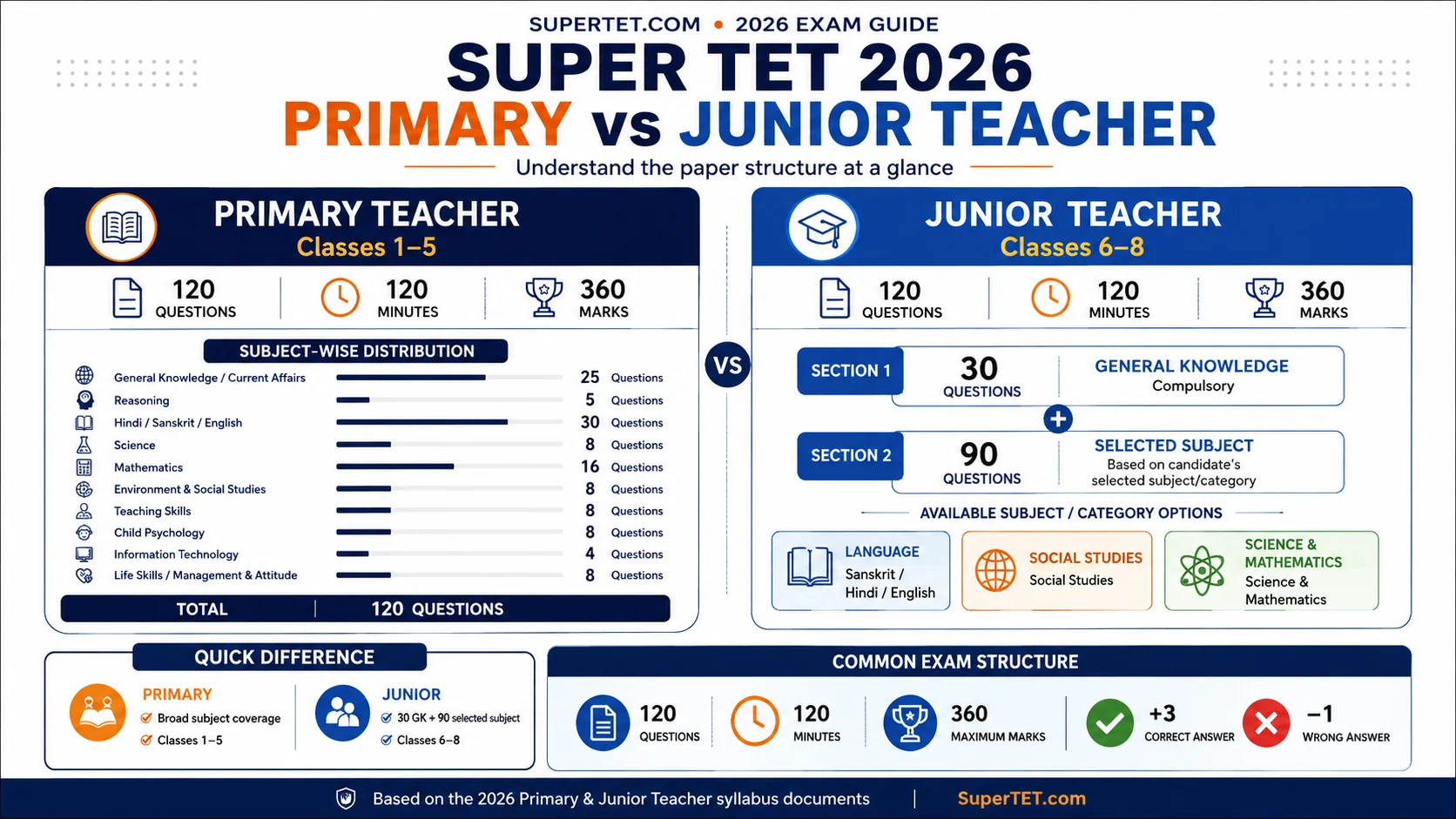
Super TET 2026 Primary and Junior Teacher comparison showing classes, question distribution and subject structures
Visual side-by-side comparison of Super TET 2026 Primary Teacher (Classes 1–5) and Junior Teacher (Classes 6–8) frameworks.

Primary Teacher Pathway & Exam Structure

The Primary Teacher pathway prepares educators for foundation and primary schooling across Classes 1 to 5. The examination tests candidates across a comprehensive 10-subject spectrum designed to reflect the multi-disciplinary requirements of early childhood and elementary classroom instruction:

Hindi / Sanskrit / English: 30 Questions (90 Marks)
General Knowledge / Current Affairs: 25 Questions (75 Marks)
Mathematics: 16 Questions (48 Marks)
Science: 8 Questions (24 Marks)
Environment & Social Studies: 8 Questions (24 Marks)
Teaching Skills: 8 Questions (24 Marks)
Child Psychology: 8 Questions (24 Marks)
Life Skills / Management & Attitude: 8 Questions (24 Marks)
Reasoning: 5 Questions (15 Marks)
Information Technology: 4 Questions (12 Marks)

Total: 120 Questions | 360 Marks | Duration: 120 Minutes. Every candidate sits for the exact same 10 subjects.

Junior Teacher Pathway & Subject Specialization

The Junior Teacher pathway appoints subject specialists for middle school education in Classes 6 to 8. Rather than testing across 10 varied areas, the exam uses a structured two-section paper that evaluates general knowledge and deep subject mastery:

  • Section 1 (General Knowledge): 30 compulsory questions (90 marks) taken by all candidates.
  • Section 2 (Selected Subject): 90 questions (270 marks) based on the candidate's chosen teaching pathway.

Junior Teacher Subject Pathways:

1. Language Teacher

Candidates select one language option: Sanskrit, Hindi, or English. All 90 subject questions evaluate that single chosen language.

2. Social Studies Teacher

Designed for humanities and social science graduates. All 90 questions evaluate historical, geographical, political, and social sciences curriculum.

3. Science & Mathematics Teacher

Designed for science and mathematics graduates. The 90 questions provide an integrated assessment of physical sciences, life sciences, and mathematics.

Key Structural Differences & Preparation Implications

Recognizing how the exam structures differ is critical for allocating revision time and selecting appropriate practice materials:

Breadth vs Depth

Primary Teacher demands broad multi-subject proficiency across 10 areas, including pedagogy, IT, child psychology, and general sciences. Junior Teacher demands deep subject specialization, where 75% of total marks (270 / 360) come from a single chosen domain.

Pedagogy & Child Psychology Weight

Primary candidates must prepare Teaching Skills, Child Psychology, and Life Skills (24 questions / 72 marks combined). For Junior candidates, pedagogical mastery is integrated into subject instruction, with testing focused heavily on the subject curriculum and general knowledge.

Negative Marking Caution

Both exams enforce the same +3/-1 rule. In Junior Teacher, deep conceptual mastery of your 90-question subject section minimizes wrong guesses. In Primary Teacher, avoiding wild guesses across 10 diverse subjects preserves hard-earned score advantages.

Official Syllabi & Exam Pattern Guides

Navigate to the detailed curriculum and exam blueprints for each teaching cadre:

Primary Teacher Syllabus →
Detailed syllabus requirements for Classes 1–5 across all 10 core subjects and pedagogy domains.
Junior Teacher Syllabus →
Curriculum breakdown for Classes 6–8 across Section 1 GK and Section 2 subject pathways.
Primary Teacher Exam Pattern →
120-question, 360-mark blueprint and subject-wise question distribution for Classes 1–5.
Junior Teacher Exam Pattern →
Two-section structure, pathway selection, and 360-mark blueprint for Classes 6–8.