
Super TET Study Plan 2026
A sustainable study plan balances disciplined daily coverage with adaptive pacing. Because candidates come from varying professional and academic backgrounds, this guide presents practical, modular scheduling frameworks that you can tailor to your available daily hours and target teacher category.
Aligning Your Plan: Primary vs Junior Frameworks
Your study schedule must reflect the specific structural reality of your target examination:
Rotate across all 14 subjects in 10 groups (120 questions, 360 marks, 120 minutes with +3/−1 marking). Prioritize Languages (30 Qs / 90 Marks), GK (25 Qs / 75 Marks), and Math (16 Qs / 48 Marks). Refer to the Primary Syllabus and Primary Exam Pattern.
Prepare for the 120-question, 360-mark paper (+3/−1 marking). Dedicate 75% of your study hours to your selected 90-question subject pathway (270 marks) and 25% to compulsory Section 1 GK (30 questions, 90 marks). Refer to the Junior Syllabus and Junior Exam Pattern.
1. How to Build Your Personal Study Plan
Rather than copying fixed schedules from other aspirants, construct your plan around three practical principles:
- Realistic Availability: Calculate your honest daily study hours excluding work, family commitments, and rest.
- Topic Weightage: Allocate slots proportionally to question counts rather than treating every subject equally.
- Built-in Buffer Time: Leave at least one evening per week open to catch up on missed targets without derailing the overall schedule.
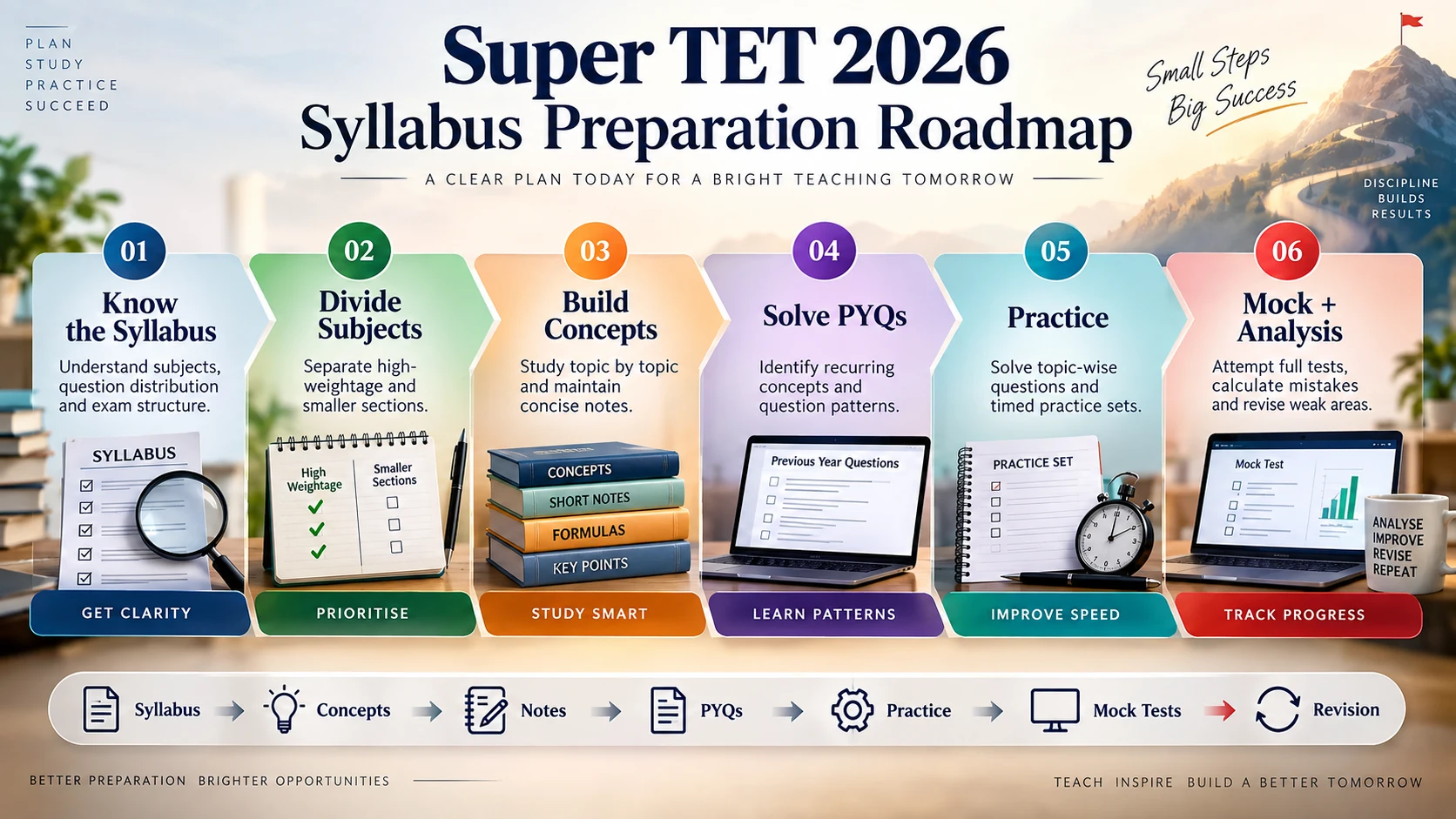
2. Daily Framework & 3. Weekly Structure
Daily 3-Block Architecture
- Block A (Morning Theory): High-focus conceptual study in heavy subjects (Mathematics, Science, or Subject Pathway).
- Block B (Afternoon Pedagogy/GK): Reading pedagogy concepts, language grammar, and UP Current Affairs.
- Block C (Evening Practice): Timed MCQ practice, question checking, and recording error log entries.
Weekly 6+1 Rhythm
- Monday to Friday: Continuous syllabus progress across scheduled subject rotations.
- Saturday: Comprehensive revision of all topics studied during the week, plus previous-year paper sets.
- Sunday: Full-length 120-minute mock test under exam conditions, followed by error log analysis.
4. Subject Rotation & 5. Learning Cycle
The 3-Phase Mastery Cycle
Every chapter should pass through three distinct phases before being marked complete:
Read foundational notes and summarize core formulas or teaching theories.
Solve 25–40 questions, practicing option elimination and testing negative marking care.
Revisit formulas on Day 3, Day 7, and Day 21 to ensure long-term memory retention.
6. PYQ Integration, 7. Mock Tests & 8. Error Notebook
Previous-Paper Integration
Integrate authentic papers into your study plan after completing 50% of the syllabus. Use them to benchmark pacing rather than treating them as mere quizzes.
Mock-Test Cadence
Begin with bi-weekly mocks during early preparation, increasing to weekly mocks in mid-preparation, and two mocks per week in the final month.
The Error Notebook
Document the reason behind every incorrect answer: conceptual gap, misread prompt, or wild guess. Review this notebook weekly to eliminate repeat errors.
10. Flexible Example Schedules by Available Study Time
Note: These schedules are practical reference examples, not mandatory official requirements. Adjust them to fit your personal workflow:
2–3 Hours / Day
- 6:00 AM – 7:15 AM (75 mins): High-weight subject concept building (Math / Subject Pathway).
- 8:30 PM – 9:30 PM (60 mins): Pedagogy, Language rules, or UP Current Affairs.
- 9:30 PM – 10:00 PM (30 mins): Timed 20-MCQ batch and error note updates.
- Weekends: Dedicate 4–5 hours on Saturday and Sunday for mock testing and consolidated revision.
4–5 Hours / Day
- Slot 1 (2 hours): Core academic topics (Math, Science, or Section 2 Subject).
- Slot 2 (1.5 hours): Pedagogy (Teaching Skills & Child Psychology) + Languages.
- Slot 3 (1 hour): Daily GK / Current Affairs notes + 30 timed MCQs.
- Slot 4 (30 mins): Day's micro-revision and mistake logging.
6+ Hours / Day
- Morning (2.5 hours): Deep concept study and chapter notes.
- Mid-day (1.5 hours): Secondary subjects (Reasoning, IT, Life Skills, Environment).
- Late Afternoon (1.5 hours): 50+ MCQ practice with negative marking simulation.
- Evening (1 hour): Daily GK consolidation and error log analysis.
11. Last-Stage Revision (Final 15 Days)
In the final 15 days before the examination, pivot your study plan entirely from new learning to consolidation:
- Zero new topics: Do not begin unfamiliar chapters during this window.
- Error notebook review: Re-read every recorded error twice.
- Formula sheet drills: Daily 20-minute reviews of math, science, and teaching principles.
- Simulated testing: Take 2 full-length 120-minute mocks during the exact time of day your exam is scheduled.