Child Psychology Section Weightage & Exam Scheme
In UP Super TET 2026 (Advt. No. 05/2026), Child Psychology (बाल मनोविज्ञान) carries 8 multiple-choice questions worth 24 marks (+3 marks per correct response, -1 mark penalty for incorrect response).
The syllabus evaluates understanding of child growth factors, individual differences, learning environments, and child-centered pedagogical design for students aged 6 to 11 years (primary school age group).
Factors Affecting Child Growth & Development
Aspirants must distinguish the core principles governing human development:
- Growth vs Development: Growth is purely quantitative (physical height, weight), measurable, and stops at physical maturity. Development is both quantitative and qualitative (cognitive, emotional, social), progressive, and continues throughout the lifespan (womb to tomb).
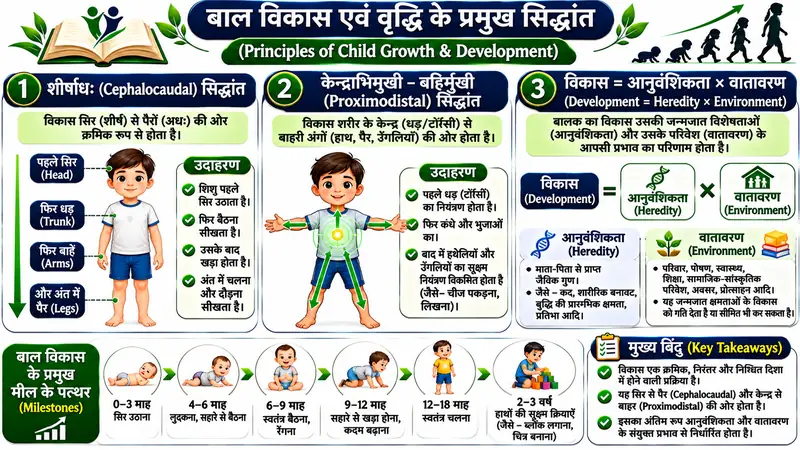
- Cephalocaudal Principle: Development proceeds from head to foot (सिर से पैर की ओर). A child gains control of their neck and head before their legs.
- Proximodistal Principle: Development proceeds from the center of the body outward (केंद्र से परिधि की ओर). A child controls their arms before their finger tips.
- Heredity & Environment: Development is the continuous product of the interaction between nature (heredity) and nurture (environment): D = H × E.
The Major Learning Theories Comparison Matrix
Review the foundational learning theories tested in UPESSC papers:
| Psychologist | Theory Name | Animal Experiment | Key Mechanism |
|---|---|---|---|
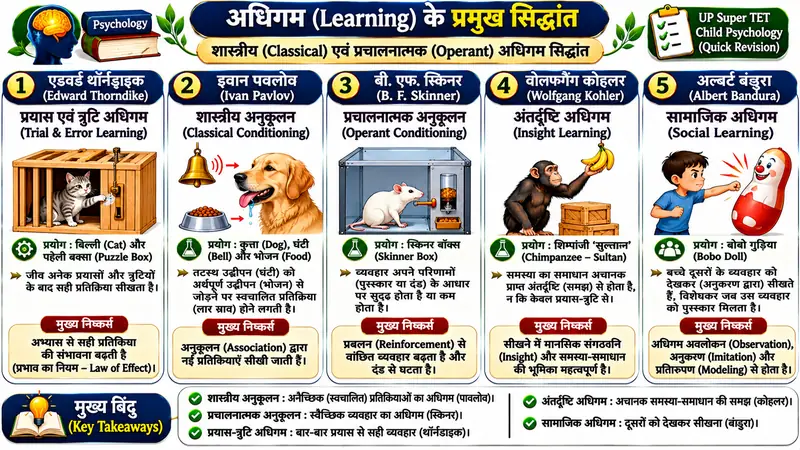
Edward Thorndike | Trial and Error (Connectionism) | Hungry Cat in Puzzle Box | S-R bond formation; Laws of Readiness, Exercise, and Effect. |
Ivan Pavlov | Classical Conditioning | Dog (Salivation) | Conditioned Stimulus (Bell) paired with Unconditioned Stimulus (Food) yields Conditioned Response. |
B.F. Skinner | Operant Conditioning | Pigeon / Rat in Skinner Box | R-S model; Reinforcement schedules strengthen desired responses. |
Wolfgang Kohler | Insight Learning (Gestalt) | Chimpanzee (Sultan) | Sudden perception of relationships ("Aha!" moment) without blind trial and error. |
Albert Bandura | Social Learning Theory | Bobo Doll Experiment | Observational learning and modeling: Attention → Retention → Reproduction → Motivation. |
Cognitive (Piaget) & Moral (Kohlberg) Theories
No Super TET paper is complete without questions from Piaget, Vygotsky, or Kohlberg:
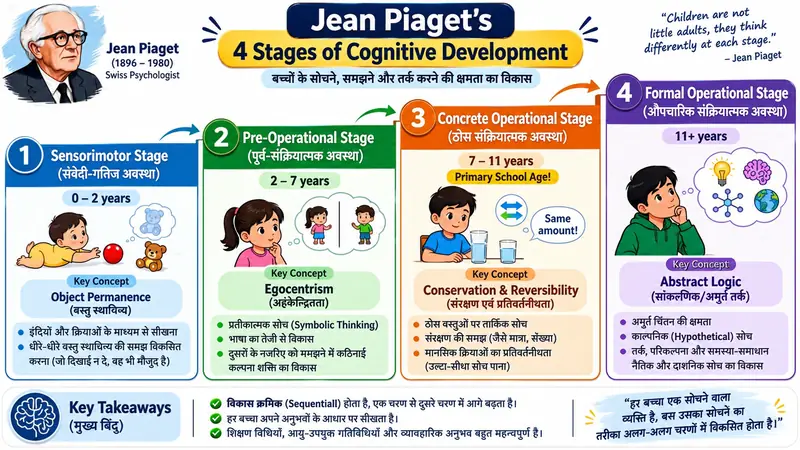
- Jean Piaget (Cognitive Development):
- Sensory-Motor (0-2 yrs): Reflexes, senses, object permanence.
- Pre-Operational (2-7 yrs): Egocentrism, animism, centration, irreversibility of thought.
- Concrete Operational (7-11 yrs): Primary school child! Reversibility, conservation of volume/mass, classification, logical operations on concrete objects.
- Formal Operational (11+ yrs): Abstract thinking and hypothetical-deductive reasoning.
- Lev Vygotsky (Socio-Cultural): Emphasized culture, language, and social interaction. Key terms: Zone of Proximal Development (ZPD) and Scaffolding.
- Lawrence Kohlberg (Moral Development): 3 levels, 6 stages centered on the Heinz dilemma.
Inclusive Education & Children with Special Needs
Primary schools in UP cater to heterogeneous student populations:
- Dyslexia: Reading disability (confusing 'b' and 'd', or 'saw' and 'was').
- Dysgraphia: Writing disability (motor coordination and illegible handwriting).
- Dyscalculia: Difficulty in mathematical calculations and number concepts.
- Gifted Children (प्रतिभाशाली बालक): IQ 140+, high creativity, abstract curiosity, rapid information processing.
15 Authentic Practice MCQs with Solutions
Test your conceptual understanding against these 15 authentic Child Psychology questions:
उत्तर एवं शिक्षक व्याख्या देखें (View Answer)
सही उत्तर: (C) मूर्त संक्रियात्मक अवस्था
व्याख्या: पियाजे की चार अवस्थाएँ हैं: 1. संवेदी पेशीय (0-2 वर्ष), 2. पूर्व संक्रियात्मक (2-7 वर्ष), 3. मूर्त संक्रियात्मक (7-11 वर्ष), 4. अमूर्त/औपचारिक (11 वर्ष से ऊपर)।
उत्तर एवं शिक्षक व्याख्या देखें (View Answer)
सही उत्तर: (B) सामाजिक अंतःक्रिया
व्याख्या: वाइगोत्स्की के सामाजिक-सांस्कृतिक सिद्धांत (Socio-cultural theory) के अनुसार बच्चे अपने से अधिक ज्ञानवान अन्य (MKO) के साथ सामाजिक संवाद से सीखते हैं।
उत्तर एवं शिक्षक व्याख्या देखें (View Answer)
सही उत्तर: (C) एडवर्ड एल. थार्नडाइक
व्याख्या: थार्नडाइक ने भूखी बिल्ली पर प्रयोग करके उद्दीपक-अनुक्रिया (S-R Bond) और प्रयास व त्रुटि का नियम दिया।
उत्तर एवं शिक्षक व्याख्या देखें (View Answer)
सही उत्तर: (A) (MA / CA) x 100
व्याख्या: विलियम स्टर्न द्वारा प्रस्तावित और लुईस टर्मन द्वारा संशोधित सूत्र: IQ = (मानसिक आयु / वास्तविक आयु) x 100.
उत्तर एवं शिक्षक व्याख्या देखें (View Answer)
सही उत्तर: (B) स्टेनली हॉल
व्याख्या: अमेरिकी मनोवैज्ञानिक जी. स्टेनली हॉल (G. Stanley Hall) ने अपनी पुस्तक 'Adolescence' में किशोरावस्था को तनाव और तूफान का काल बताया।
उत्तर एवं शिक्षक व्याख्या देखें (View Answer)
सही उत्तर: (B) गेस्टाल्टवाद
व्याख्या: कोहलर, कोफ्का और वर्थीमर के गेस्टाल्ट संप्रदाय ने सुल्तान नामक चिम्पांजी पर प्रयोग कर सूझ का सिद्धांत प्रतिपादित किया।
उत्तर एवं शिक्षक व्याख्या देखें (View Answer)
सही उत्तर: (B) मरे एवं मॉर्गन
व्याख्या: Thematic Apperception Test (TAT) का निर्माण 1935 में सी.डी. मॉर्गन और हेनरी ए. मरे द्वारा किया गया था।
उत्तर एवं शिक्षक व्याख्या देखें (View Answer)
सही उत्तर: (B) बी.एफ. स्किनर
व्याख्या: बी.एफ. स्किनर ने सफेद चूहों और कबूतरों पर प्रयोग कर पुनर्बलन आधारित क्रिया प्रसूत अनुबंधन का प्रतिपादन किया।
उत्तर एवं शिक्षक व्याख्या देखें (View Answer)
सही उत्तर: (B) 3 स्तर और 6 अवस्थाएँ
व्याख्या: कोहलबर्ग ने 3 मुख्य स्तर (पूर्व-पारंपरिक, पारंपरिक, उत्तर-पारंपरिक) और कुल 6 क्रमिक अवस्थाओं का प्रतिपादन किया।
उत्तर एवं शिक्षक व्याख्या देखें (View Answer)
सही उत्तर: (B) नकारात्मक (ऋणात्मक) स्थानांतरण
व्याख्या: जब पूर्व अर्जित अनुभव नवीन ज्ञान सीखने में रुकावट डाले, तब उसे नकारात्मक स्थानांतरण कहते हैं।
उत्तर एवं शिक्षक व्याख्या देखें (View Answer)
सही उत्तर: (B) व्यक्तित्व
व्याख्या: रोर्शा स्याही धब्बा परीक्षण और TAT जैसी प्रक्षेपणात्मक विधियों का उपयोग अचेतन मन की प्रेरणाओं और व्यक्तित्व मापन में होता है।
उत्तर एवं शिक्षक व्याख्या देखें (View Answer)
सही उत्तर: (A) हॉवर्ड गार्डनर
व्याख्या: हॉवर्ड गार्डनर ने 1983 में 'Frames of Mind' पुस्तक में भाषाई, तार्किक, संगीतमय सहित बहुबुद्धि का सिद्धांत प्रस्तुत किया।
उत्तर एवं शिक्षक व्याख्या देखें (View Answer)
सही उत्तर: (A) जेरोम ब्रूनर और वाइगोत्स्की
व्याख्या: बालक को किसी कार्य को स्वतंत्र रूप से करने योग्य बनाने के लिए दी जाने वाली अस्थायी सहायता को ब्रूनर और वाइगोत्स्की ने स्काफोल्डिंग कहा।
उत्तर एवं शिक्षक व्याख्या देखें (View Answer)
सही उत्तर: (B) अपसारी चिंतन (Divergent Thinking)
व्याख्या: अपसारी चिंतन (विविध दिशाओं में मौलिक और नवीन विचार उत्पन्न करना) सृजनात्मक बालक की मुख्य विशेषता है।
उत्तर एवं शिक्षक व्याख्या देखें (View Answer)
सही उत्तर: (B) द्विकारक (g-कारक एवं s-कारक)
व्याख्या: चार्ल्स स्पीयरमैन ने सामान्य मानसिक क्षमता (General factor 'g') और विशिष्ट क्षमता (Specific factor 's') का द्विकारक सिद्धांत दिया।
Continue your preparation with our Teaching Skills Guide and explore our full Syllabus Map.
Frequently Asked Questions
How many marks does Child Psychology carry in UP Super TET?
Child Psychology carries 8 questions worth 24 marks (+3 correct, -1 penalty) under Advt. No. 05/2026.
Which developmental stage corresponds to the primary school child?
Primary school children (aged 6 to 11 years) fall in the Late Childhood stage and Piaget's Concrete Operational Stage.
Who propounded the Insight Theory of Learning?
Wolfgang Kohler, along with Max Wertheimer and Kurt Koffka under the Gestalt school of psychology, propounded the Insight Theory through experiments on the chimpanzee Sultan.