English Section Weightage & Pattern
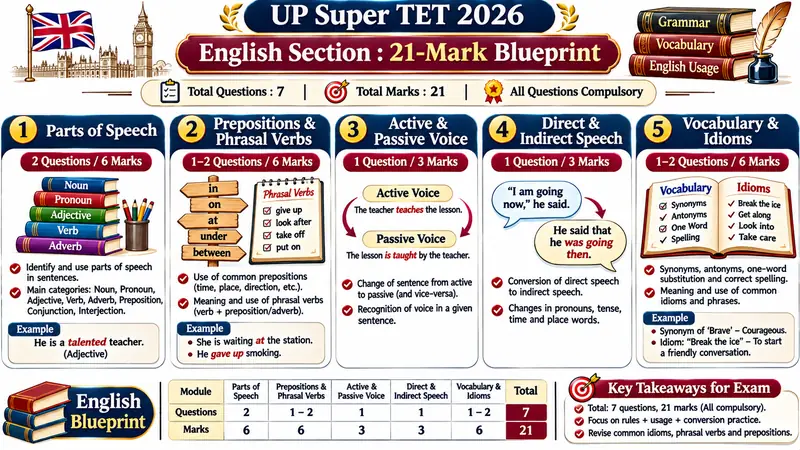
In UP Super TET 2026 (Advt. No. 05/2026), General English carries 7 questions worth 21 marks (+3 marks for correct answer, -1 mark for wrong answer).
Unlike UPTET where candidates can choose between English, Sanskrit, or Urdu, in Super TET English is 100% compulsory. You cannot opt out. However, the standard tested is Matriculation/Secondary level, focusing on fundamental syntax, accurate preposition usage, and voice/narration transformations.
High-Yield Grammar Rules & Syllabus Breakdown
The 7 questions are consistently drawn from these core syntactic domains:
| Topic Domain | Expected Qs | Essential Rules to Master |
|---|---|---|
Parts of Speech | 2 Qs | Identifying noun types (abstract/collective), pronoun cases, adjective degrees of comparison, adverb placement, and conjunction pairs (neither..nor, scarcely..when). |
Prepositions & Phrasal Verbs | 1 – 2 Qs | Fixed prepositions (congratulate on, rely on, senior to, refrain from, deal in/with, look after/for). |
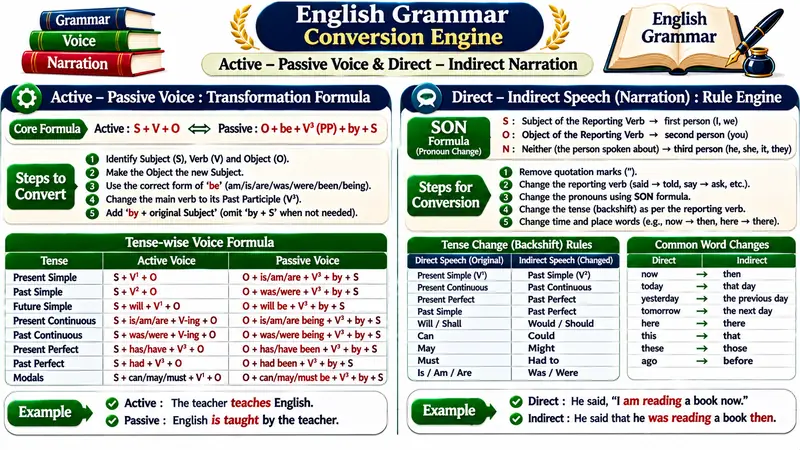
Active & Passive Voice | 1 Q | Transformation rules across tenses; imperative sentences (Let + object + be + V3); modal auxiliaries. |
Direct & Indirect Speech | 1 Q | Reporting verb changes in past tense; pronoun shifts (SON formula); change of time/place markers (now → then, here → there). |
Vocabulary & Idioms | 1 – 2 Qs | High-frequency synonyms/antonyms, one-word substitutions (omniscient, philanthropist), and spelling error identification. |
Teacher Strategy for Hindi-Medium Aspirants
If you have studied in Hindi-medium schools, English often feels like a gamble. Follow these three structural guidelines:
- Treat Voice and Narration as Mathematical Formulas: Active to Passive and Direct to Indirect speech follow strict, unvarying algebraic rules. Master the conversion chart and you will lock 6 marks in under 60 seconds.
- Memorize the Top 50 Fixed Prepositions: In English, verbs take mandatory prepositions (e.g., accustomed to, prevent from, abstain from, fond of). 90% of exam preposition questions test fixed phrases rather than spatial rules.
- Subject-Verb Agreement Rules: Remember that singular subjects joined by 'neither..nor' or 'either..or' take singular verbs, while collective nouns take singular verbs unless divided.
Common English Traps Under Negative Marking
Watch out for these common errors:
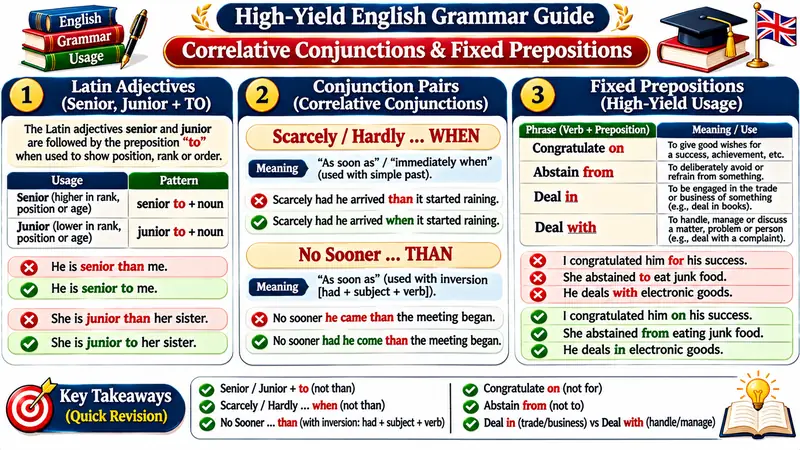
- Latin Adjectives: Words like senior, junior, superior, inferior, prior take 'to', never 'than'. (e.g., "He is senior to me", not "senior than me").
- Scarcely / Hardly: Always followed by 'when', never 'than'. (e.g., "Hardly had I arrived when it began to rain").
- No Sooner: Always followed by 'than', never 'when'. (e.g., "No sooner did the bell ring than the students dispersed").
7-Day English Revision Sprint
- Day 1: Parts of Speech identification and Subject-Verb Agreement.
- Day 2: Tenses chart and conditional sentence structures (If + Past Perfect → would have + V3).
- Day 3: Active and Passive voice transformations across all 8 passive tenses.
- Day 4: Direct and Indirect narration conversions (Assertive, Interrogative, Imperative).
- Day 5: Master 50 fixed prepositions and commonly confused words.
- Day 6: Practice 50 high-yield one-word substitutions and idioms.
- Day 7: Solve past Super TET English sections and practice error spotting.
16 Practice MCQs with Detailed Solutions
Practice these 16 syllabus-aligned English MCQs to test your grammar and vocabulary readiness:
View Correct Answer & Explanation
Correct Option: (B) The honest student was praised by the teacher.
Pedagogical Explanation: Past simple 'praised' changes to 'was praised' in passive voice with past tense agreement.
View Correct Answer & Explanation
Correct Option: (A) in
Pedagogical Explanation: The adjective 'proficient' correctly takes the preposition 'in' when referring to a field of study or skill.
View Correct Answer & Explanation
Correct Option: (B) Frank
Pedagogical Explanation: 'Candid' means truthful, straightforward, and frank.
View Correct Answer & Explanation
Correct Option: (B) Accommodation
Pedagogical Explanation: 'Accommodation' has double 'c' and double 'm'.
View Correct Answer & Explanation
Correct Option: (C) Adverb
Pedagogical Explanation: 'Bravely' modifies the verb 'fought', answering 'how' he fought, hence it is an adverb of manner.
View Correct Answer & Explanation
Correct Option: (B) Careless
Pedagogical Explanation: 'Meticulous' means showing great attention to detail; its exact antonym is 'Careless'.
View Correct Answer & Explanation
Correct Option: (B) had studied
Pedagogical Explanation: Third conditional structure: If + past perfect (had studied), would have + past participle.
View Correct Answer & Explanation
Correct Option: (B) Future Perfect
Pedagogical Explanation: The form 'will have + past participle' expresses an action that will be completed before a specific time in the future.
View Correct Answer & Explanation
Correct Option: (A) Bibliophile
Pedagogical Explanation: A bibliophile is an admirer or collector of books.
View Correct Answer & Explanation
Correct Option: (B) Crises
Pedagogical Explanation: Nouns ending in '-is' derived from Greek change to '-es' in plural, pronounced /krai-seez/.
View Correct Answer & Explanation
Correct Option: (B) To reveal a secret prematurely
Pedagogical Explanation: 'To spill the beans' means to disclose confidential information indiscreetly.
View Correct Answer & Explanation
Correct Option: (B) Neither of the boys was present.
Pedagogical Explanation: 'Neither' is a singular distributive pronoun and requires the singular verb 'was'.
View Correct Answer & Explanation
Correct Option: (B) Clear
Pedagogical Explanation: 'Vague' means uncertain or indistinct; its antonym is 'Clear'.
View Correct Answer & Explanation
Correct Option: (A) 'Help!' shouted the boy, 'I cannot swim.'
Pedagogical Explanation: Exclamation mark inside quotation marks, followed by dialogue tag and second quotation block.
View Correct Answer & Explanation
Correct Option: (B) Pride
Pedagogical Explanation: A group of lions is known as a 'pride'.
View Correct Answer & Explanation
Correct Option: (B) than
Pedagogical Explanation: 'No sooner... than' is a correlative conjunction pair; 'hardly/scarcely' takes 'when'.
Review related subjects in our Complete Syllabus Hub and check our 30-Day Preparation Plan.
Frequently Asked Questions
Is English compulsory in UP Super TET 2026?
Yes. English is a compulsory subject carrying 7 questions (21 marks). Candidates cannot substitute it with Sanskrit or Urdu.
What is the standard of English questions in Super TET?
Questions are framed up to Class 10/Matriculation standard, focusing primarily on foundational grammar, prepositions, voice, narration, and basic vocabulary.
Which book is recommended for Super TET English?
Objective General English by S.P. Bakshi (Arihant) or High School English Grammar by Wren & Martin provide the most precise coverage.