UP Super TET Syllabus 2026: Framework at a Glance
The official UP Super TET 2026 syllabus comprises 14 subjects organized into 10 composite examination sections carrying a total of 120 questions (360 marks).
Under the official notification released by the Uttar Pradesh Education Service Selection Commission (UPESSC Advt. No. 05/2026), the academic difficulty of academic subjects (Languages, Mathematics, Science, and Social Studies) is calibrated to the Class 10th and 12th standards, while professional sections (Teaching Skills, Child Psychology, and Life Skills) adhere to the 2-year D.El.Ed (BTC) training curriculum.

Please note that UPESSC Advertisement No. 05/2026 applies exclusively to Primary Assistant Teachers (Classes 1 to 5). A separate Upper Primary / Junior stream has not been notified under Advt 05/2026. Therefore, the single primary curriculum detailed below is the only official syllabus for this examination.
The 14-Subject Curriculum Directory
Click on any individual subject below to access its comprehensive syllabus breakdown, topic-wise strategy, formula sheets, and 15+ verified practice questions:
| Subject | Core Focus Areas | Questions | Marks | In-Depth Guide |
|---|---|---|---|---|
Hindi (हिंदी) | व्याकरण, अपठित गद्यांश/पद्यांश, प्रमुख रचनाकार एवं साहित्य | 16 Qs | 48 M | Hindi Prep Guide → |
English | Grammar rules, parts of speech, vocabulary, unseen passage | 7 Qs | 21 M | English Prep Guide → |
Sanskrit (संस्कृतम्) | व्याकरण, शब्दरूप, धातुरूप, सन्धि, समास एवं अपठित श्लोक | 7 Qs | 21 M | Sanskrit Prep Guide → |
GK & Current Affairs | UP GK, national/international events, Indian history & constitution | 25 Qs | 75 M | GK Strategy → |
Mathematics | Numerical ability, algebra, arithmetic, geometry, mensuration | 16 Qs | 48 M | Maths Formulas → |
Science | Motion, force, energy, light, chemical substances, human biology | 8 Qs | 24 M | Science Strategy → |
Environmental Studies | Ecosystem, biodiversity, pollution, conservation, natural resources | 8 Qs | 24 M | EVS Notes → |
Social Studies | Indian freedom struggle, polity, geography, state administration | 8 Qs | 24 M | SST Notes → |
Teaching Skills (शिक्षण कौशल) | Teaching methods, learning principles, evaluation, inclusive education | 8 Qs | 24 M | Teaching Skills → |
Child Psychology (बाल मनोविज्ञान) | Developmental factors, learning laws, individual differences, theories | 8 Qs | 24 M | Child Psychology → |
Life Skills (जीवन कौशल) | Professional ethics, constitutional values, motivation, stress management | 8 Qs | 24 M | Life Skills Notes → |
Management & Attitude | School governance, SMC rules, administrative conduct, RTE standards | 7 Qs | 21 M | Management Guide → |
Logical Reasoning | Analogies, coding-decoding, number series, Venn diagrams, directions | 5 Qs | 15 M | Reasoning Guide → |
Information Technology (IT) | Digital tools, DIKSHA/MOOC, educational technology, internet basics | 4 Qs | 12 M | Computer Syllabus → |
| Total Composite Examination | 120 Questions | 360 Marks | 120-Q Exam Pattern → | |
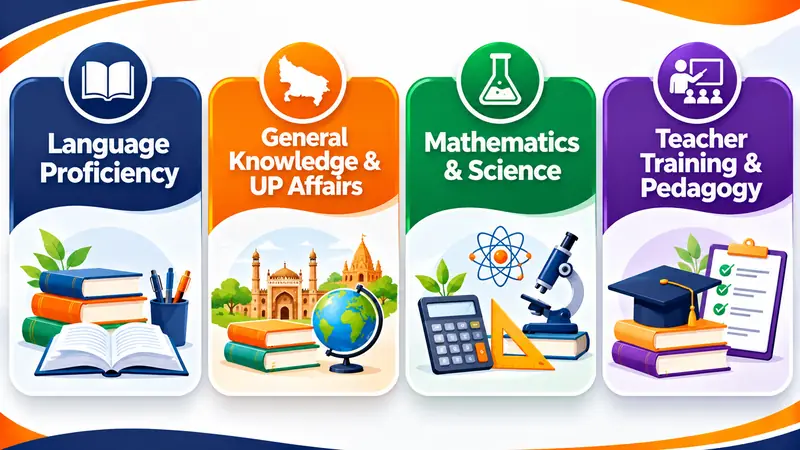
Detailed Section-by-Section Topic Breakdown
1. Languages (Hindi, English & Sanskrit — 30 Qs / 90 Marks)
The language domain is tested across three languages. Hindi carries the predominant weightage (16 questions), with English and Sanskrit each allotted 7 questions:
- Hindi: वर्णमाला, सन्धि (स्वर, व्यंजन, विसर्ग), समास, तत्सम-तद्भव, विलोम, पर्यायवाची, अनेकार्थी, उपसर्ग-प्रत्यय, मुहावरे एवं लोकोक्तियाँ, रस-छन्द-अलंकार, अपठित गद्यांश, और उत्तर प्रदेश के प्रमुख साहित्यकार एवं उनकी रचनाएँ।
- English: Parts of speech, active and passive voice, direct and indirect speech, sentence transformation, subject-verb agreement, idioms, synonyms/antonyms, one-word substitution, and reading comprehension.
- Sanskrit: माहेश्वर सूत्र, प्रत्याहार, संज्ञा, सन्धि, समास, शब्दरूप (राम, हरि, नदी, लता, अस्मद्, युष्मद्), धातुरूप (लट्, लोट्, लङ्, विधिलिङ्, लृट्), कारक एवं विभक्तियाँ, संख्या ज्ञान (1 से 100), और प्रसिद्ध नीति सूक्तियाँ।
2. General Knowledge & Current Affairs (25 Qs / 75 Marks)
As the single largest scoring section in the entire examination, this domain demands balanced attention to static foundation and current events:
- National & International Current Affairs: Major national events, government schemes, awards and honors, sports tournaments, scientific milestones, and bilateral summits over the preceding 12 months.
- Uttar Pradesh Special GK: History, cultural heritage, folk arts, festivals, industrial hubs (ODOP - One District One Product), wildlife sanctuaries, rivers, and geographic landscape of Uttar Pradesh.
- Static General Knowledge: Indian national movement, fundamental rights, Directive Principles, parliamentary procedures, physical geography of India, and Indian economic basics.
3. Mathematics (16 Qs / 48 Marks)
Covering arithmetic, commercial maths, and introductory geometry up to Class 10th standard:
- Number system, fractions, decimals, HCF and LCM, percentage, profit and loss, simple and compound interest.
- Ratio and proportion, unitary method, work and time, speed and distance.
- Algebraic identities, linear equations, basic statistics (mean, median, mode).
- Plane geometry: properties of triangles, circles, quadrilaterals, perimeter, and area (mensuration).
4. Science, Environmental & Social Studies (24 Qs / 72 Marks)
- Science (8 Qs): State of matter, speed, force, work and energy, reflection/refraction of light, sound propagation, electric current, human organ systems, balanced diet, and communicable diseases.
- Environment & Social Studies (16 Qs across EVS & SST): Structure of the earth, atmosphere, rivers and mountains of India, mineral resources, ecosystem dynamics, ozone layer protection, national freedom movement, social reformers, Indian constitution, local self-government (Panchayati Raj), and disaster management.
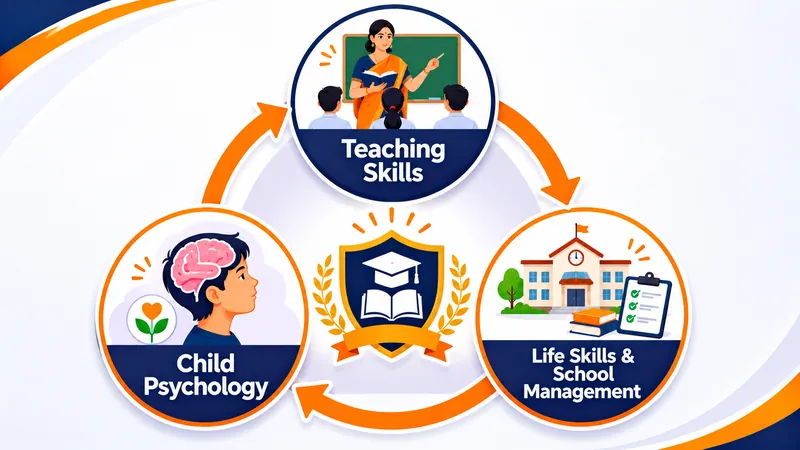
5. Professional Pedagogy & Psychology (31 Qs / 93 Marks)
- Teaching Skills (8 Qs): Teaching methods, maxims of teaching (शिक्षण सूत्र), microteaching, lesson planning, continuous and comprehensive evaluation (CCE), new trends in primary education, and inclusive classroom practices.
- Child Psychology (8 Qs): Factors influencing child development, learning theories (Thorndike, Pavlov, Skinner, Kohler), Jean Piaget's cognitive stages, Vygotsky's socio-cultural theory, and accommodating individual differences.
- Life Skills, Management & Attitude (15 Qs combined): Professional conduct for educators, constitutional and humanitarian values, motivation theories (Maslow's hierarchy), positive reinforcement, conflict resolution, school management committees (SMC), and Right to Education Act 2009 (RTE) compliance.
6. Reasoning & Information Technology (9 Qs / 27 Marks)
- Logical Reasoning (5 Qs): Analogies, assertions and reasons, series completion, coding-decoding, blood relations, direction sense, and Venn diagrams.
- Information Technology (4 Qs): Computer architecture, memory types, internet browsers, search techniques, digital education platforms (DIKSHA, SWAYAM, e-Pathshala), and basic digital literacy for primary school administration.
What Changed from the Old Pattern to 2026?
| Parameter | Old 2018-2019 Scheme | Official 2026 UPESSC Scheme | Preparation Implication |
|---|---|---|---|
| Total Questions | 150 Questions | 120 Questions | More time per question (1 min vs 48 sec) |
| Total Marks | 150 Marks (1 mark each) | 360 Marks (3 marks each) | Higher stakes per individual question |
| Negative Marking | Zero deduction (0) | -1 Mark per Wrong Answer | Guesswork penalized heavily; accuracy vital |
| Merit System | 60% Written + 40% Academic | 100% Written Exam Score | Academic marks used only as tie-breaker |
Official Syllabus PDF Access & Downloads
Aspirants may review and download the official UPESSC notification syllabus documents directly below:
Download the authentic UP Education Service Selection Commission (UPESSC) official syllabus PDFs verified against Advt. No. 05/2026:
Issued by: Uttar Pradesh Education Service Selection Commission (UPESSC), Prayagraj.
Frequently Asked Questions
Which subject carries the highest marks in Super TET 2026?
General Knowledge and Current Affairs carries the highest individual section weightage with 25 questions (75 marks), followed by Hindi (16 questions / 48 marks) and Mathematics (16 questions / 48 marks).
Are Sanskrit and English both compulsory in Super TET?
Yes. In the composite Language section (30 questions total), candidates are tested on Hindi (16 Qs), English (7 Qs), and Sanskrit (7 Qs). Unlike UPTET where you choose between English, Sanskrit, or Urdu, Super TET tests all three foundational languages.
Is there any change in the syllabus topics for 2026?
While the core thematic areas remain anchored in standard primary pedagogy and general education, the total question count was re-allocated from 150 to 120 questions with 3 marks per question and negative marking.