UP Super TET Exam Pattern at a Glance
The UP Super TET 2026 written examination consists of 120 objective multiple-choice questions (MCQs) carrying a total of 360 marks, to be completed in 2 hours (120 minutes) on an offline OMR answer sheet.
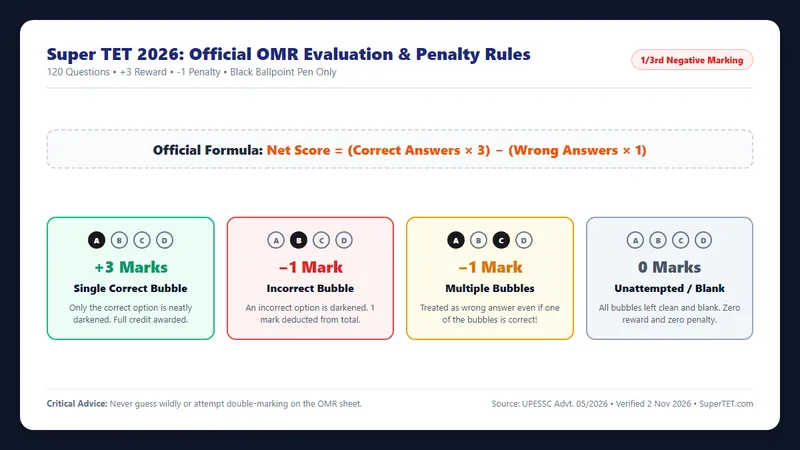
Under the official regulations of UPESSC Advertisement No. 05/2026, the paper awards +3 marks for every correct response and deducts -1 mark for every incorrect or multiple-marked bubble. Questions left blank receive zero marks without penalty.

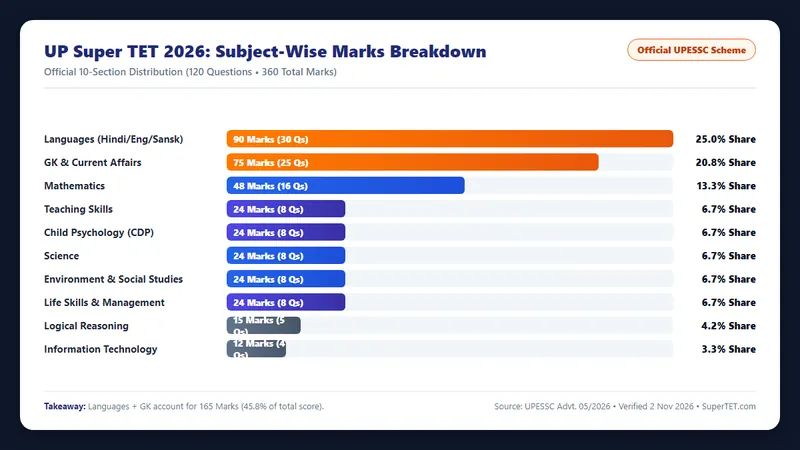
Subject-Wise Questions and Marks Distribution
The single composite test paper evaluates candidates across 10 distinct subject domains (incorporating 14 curricular subjects). Below is the officially verified allocation matrix:
| Subject / Section | Questions | Marks | Weightage (%) | Standard / Level | Status |
|---|---|---|---|---|---|
| Languages (Hindi, English, Sanskrit) | 30 | 90 | 25.0% | Class 12th / D.El.Ed Level | Official |
| General Knowledge & Current Affairs | 25 | 75 | 20.8% | Graduate / National & UP Level | Official |
| 16 | 48 | 13.3% | Class 10th (Secondary) Level | Official | |
| 8 | 24 | 6.7% | Class 10th (Secondary) Level | Official | |
| 8 | 24 | 6.7% | Class 10th (Secondary) Level | Official | |
| 8 | 24 | 6.7% | D.El.Ed (BTC) Professional Level | Official | |
| 8 | 24 | 6.7% | D.El.Ed (BTC) Professional Level | Official | |
| 8 | 24 | 6.7% | D.El.Ed (BTC) Professional Level | Official | |
| 5 | 15 | 4.2% | General Aptitude | Official | |
| 4 | 12 | 3.3% | Basic Digital & Educational Tech | Official | |
Total Super TET Paper | 120 Questions | 360 Marks | 100% | Composite Written Test | Official |
Marking Scheme & Negative Penalty Rules
The mathematical formula applied to calculate your final score is:
Net Score = (Number of Correct Answers × 3) − (Number of Incorrect Answers × 1)
Critical OMR rules governing the examination:
- Multiple Bubbles Count as Negative: If you darken more than one circle for a single question on the OMR sheet, it is treated as an incorrect response, resulting in a deduction of 1 mark, even if one of the marked bubbles is the correct option.
- Unattempted Questions Carry Zero: Leaving a bubble clean and blank carries neither positive reward nor penalty deduction.
- Pen Requirement: Only black ballpoint pens are authorized. Gel pens, pencils, and fluid erasers (whiteners) are strictly prohibited and will cause OMR rejection.
Interactive Super TET Score & Penalty Calculator
Use our client-side calculator below to model your expected net score, percentage, and accuracy based on your estimated correct and incorrect attempts:
Worked Scoring Scenarios: Accuracy vs. Blind Guessing
To demonstrate why blind guessing under negative marking destroys a candidate's merit rank, consider two aspirants sitting for the 2026 examination:
| Metric | Candidate A (Blind Guesser) | Candidate B (Disciplined Aspirant) | Difference & Takeaway |
|---|---|---|---|
Questions Attempted | 120 (All questions) | 95 (Selective attempts) | Candidate A attempted 25 more questions |
Correct Responses | 80 Correct | 88 Correct | Candidate B maintained focused precision |
Incorrect Responses | 40 Wrong | 7 Wrong | Candidate A suffered 40 wrong answers |
Gross Marks Earned | 80 × 3 = 240 Marks | 88 × 3 = 264 Marks | Candidate B leads by +24 marks |
Negative Penalty Deducted | 40 × 1 = -40 Marks | 7 × 1 = -7 Marks | Candidate A loses a massive 40 marks |
Final Net Score | 200 / 360 (55.5%) | 257 / 360 (71.4%) | Candidate B leads by 57 Marks! |
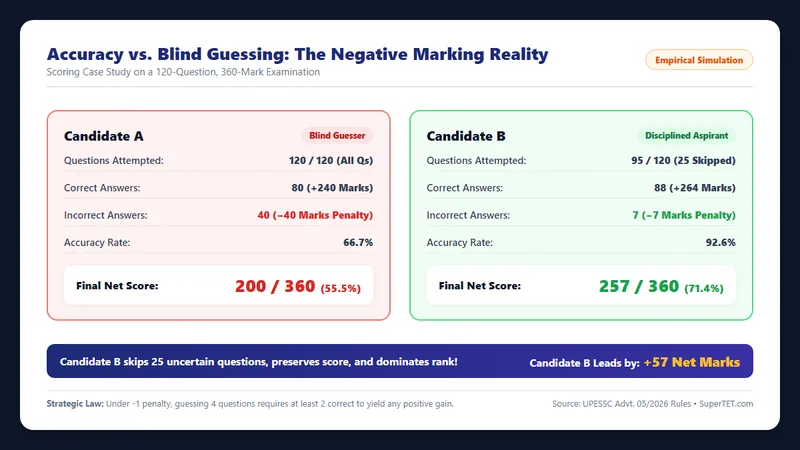
As the table demonstrates, Candidate B, despite skipping 25 difficult questions, finishes with a dominant 257 marks compared to Candidate A's 200 marks. In state-level recruitment where cut-offs are separated by fractions of a mark, disciplined restraint is the ultimate differentiator.
Historic Comparison: 2018 vs. 2019 vs. 2026 Patterns
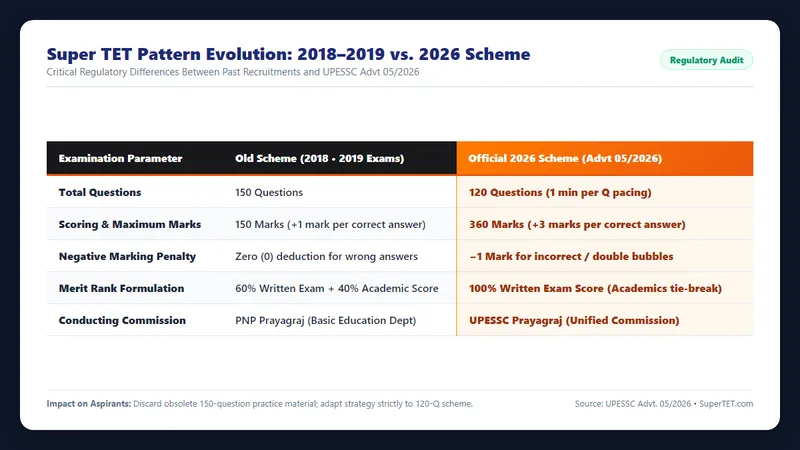
Understanding how the UP Super TET evolved prevents candidates from adopting outdated strategies found in older books:
| Parameter | Old 2018–2019 Scheme | Official 2026 UPESSC Scheme | Preparation Implication |
|---|---|---|---|
| Total Questions | 150 Questions | 120 Questions | More time per question (1 min vs 48 sec) |
| Total Marks | 150 Marks (1 mark each) | 360 Marks (3 marks each) | Higher stakes per individual question |
| Negative Marking | Zero deduction (0) | -1 Mark per Wrong Answer | Guesswork penalized heavily; accuracy vital |
| Merit System | 60% Written + 40% Academic | 100% Written Exam Score | Academic marks used only as tie-breaker |
Frequently Asked Questions
How many questions are there in Super TET 2026?
The exam consists of 120 multiple choice questions carrying 360 total marks under UPESSC Advt 05/2026.
What is the negative marking deduction in Super TET 2026?
For every incorrect response or question where multiple circles are darkened, 1 mark is deducted from your aggregate score. Leaving a question blank incurs zero deduction.
What is the passing percentage in Super TET 2026?
The expected minimum qualifying threshold set by the Commission is 65% for Unreserved/EWS (234/360) and 60% for OBC, SC, ST, and PwD (216/360). However, actual appointment depends on competitive merit rank among the 12,405 vacancies.