The Practitioner Mindset: Accuracy Beats Volume
Preparing for UP Super TET 2026 requires an entirely different strategy from previous years. In 2018 and 2019, candidates could rely on passive memorization and aggressive guessing because wrong answers carried zero penalty. Under the 2026 UPESSC scheme, every wrong bubble deducts 1 full mark from your score.
As teachers who have appeared in the examination, our first message to every aspirant is: Do not try to master all 14 subjects equally from day one. Success in Super TET is an exercise in resource allocation. You must secure the high-weightage scoring anchors (General Knowledge, Hindi, Mathematics, and Pedagogy) before spreading your attention across micro-sections.
Subject Prioritization: Return on Study Hours (ROI)
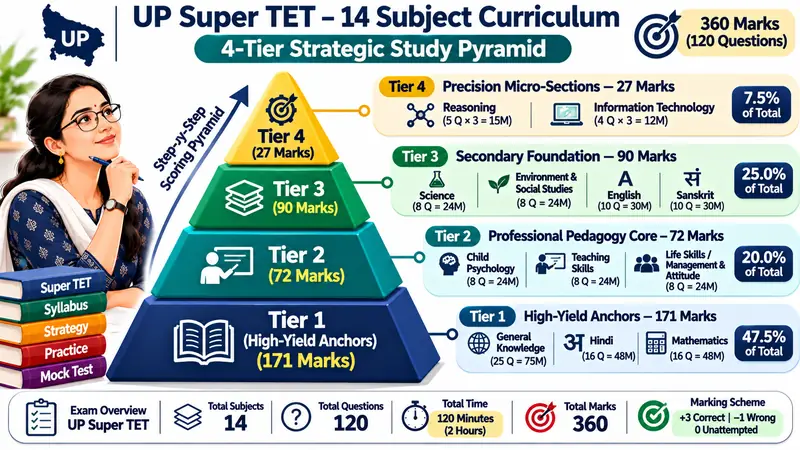
To maximize your marks within limited study weeks, group the 14 subjects into four strategic tiers based on their marks yield relative to the preparation effort required:
| Tier | Subject Areas | Total Weightage | Strategic Role |
|---|---|---|---|
Tier 1: High-Yield Anchors | GK & Current Affairs (75 M) + Hindi (48 M) + Maths (48 M) | 171 Marks (47.5%) | Daily practice essential; determines your baseline ranking. |
Tier 2: Professional Core | Teaching Skills (24 M) + Child Psychology (24 M) + Life Skills (24 M) | 72 Marks (20.0%) | Revise D.El.Ed (BTC) textbooks; high conceptual consistency. |
Tier 3: Secondary Foundation | English (21 M) + Sanskrit (21 M) + Science (24 M) + EVS/SST (24 M) | 90 Marks (25.0%) | NCERT/SCERT Class 6-10 textbooks; focus on high-frequency topics. |
Tier 4: Precision Micro-Sections | Logical Reasoning (15 M) + Information Technology (12 M) | 27 Marks (7.5%) | Requires only 10-12 hours of total study; high accuracy yield. |
Daily Study Timetables: Full-Time vs. Working Aspirants
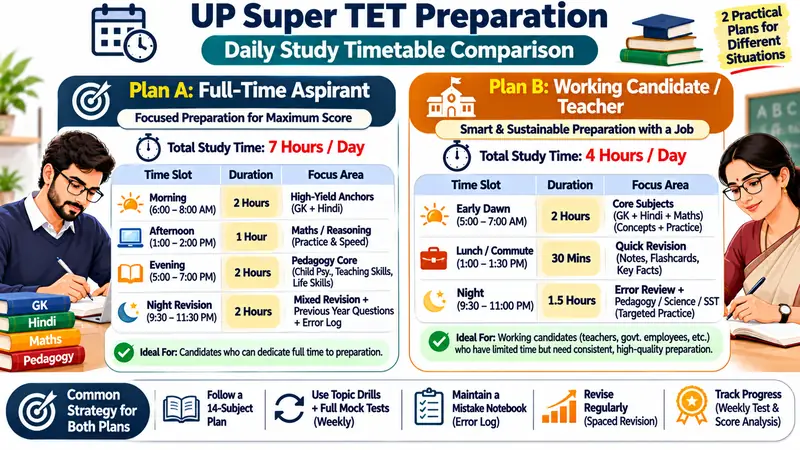
Your timetable must be sustainable. Avoid unrealistic 14-hour plans that lead to burnout after 5 days. Choose the framework matching your life situation:
Plan A: Full-Time Aspirant (6.5 – 7.5 Hours Daily)
- Morning Block 1 (06:30 – 08:30 AM): Mathematics & Numerical Ability (fresh mind, active problem-solving).
- Morning Block 2 (09:30 – 11:30 AM): General Knowledge & Current Affairs (newspaper analysis, UP special facts, static notes).
- Afternoon Block (02:00 – 03:30 PM): Child Psychology & Teaching Skills (concept reading and theory summarization).
- Evening Block (05:00 – 06:30 PM): Languages (alternating Hindi grammar with English / Sanskrit Shabdroop).
- Night Revision Block (08:30 – 09:30 PM): Rapid MCQ practice or solving 20 questions from our Question Bank.
Plan B: Working Aspirant / Teacher / Homemaker (3.5 – 4 Hours Daily)
- Early Morning Block (05:30 – 07:00 AM): Mathematics or Science concepts (uninterrupted focused study).
- Commute / Lunch Break (30 – 45 Mins): Digital flashcards, current affairs bullet points, or mobile practice on our Mock Test Portal.
- Evening / Night Block (08:30 – 10:30 PM): Pedagogy, Language grammar rules, and 30 minutes of daily error revision.
- Weekend Surge: Dedicate 6 hours on Saturday and Sunday exclusively to full-length timed mock tests and detailed error analysis.
The 1-3-7 Revision Loop: Retaining 14 Subjects
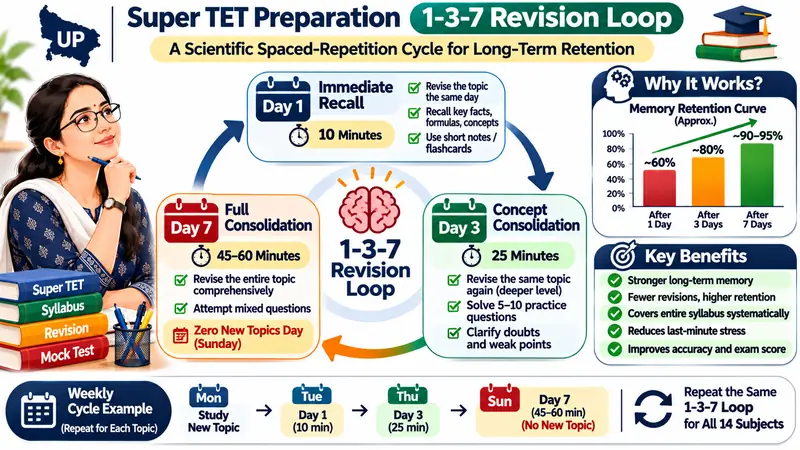
Because the Super TET syllabus spans history, science, pedagogy, and grammar, memory decay is the candidate's greatest enemy. Apply the 1-3-7 Revision Loop:
- Day 1 (Immediate Review): Spend 10 minutes at the end of each study session reviewing what you wrote down that day.
- Day 3 (First Recall Loop): Before beginning new topics on Day 3, spend 25 minutes reviewing notes from Day 1.
- Day 7 (Weekly Consolidation): Every Sunday is a "Zero New Study" day. Dedicate the entire day to re-reading your compiled summary sheets and solving chapter-wise MCQs.
The 3-Bucket Mock Test Analysis Method
Taking a mock test without analyzing your mistakes is almost useless. Whenever you complete a practice test on our Mock Engine, sort every question you got wrong or skipped into three distinct buckets:
- Bucket 1: Pure Conceptual Gap: You did not know the concept (e.g., Piaget's specific sub-stage or a Sanskrit Sandhi formula). Action: Open your textbook, learn the rule, and write it in your dedicated "Error Diary."
- Bucket 2: Question Misread (Silly Mistake): You knew the concept but failed to notice words like "NOT", "EXCEPT", or confused positive and negative options. Action: Circle the keyword next time and slow down during reading.
- Bucket 3: Bad Gamble (Negative Penalty): You were completely uncertain between three options and guessed blindly, losing 1 mark. Action: Train yourself to skip questions where you cannot logically eliminate at least two choices.
5 Fatal Preparation Mistakes to Avoid
- Neglecting UP Special GK: Spending months on world geography while ignoring Uttar Pradesh history, wildlife sanctuaries, and state agriculture. UP GK carries significant weight in the 25-mark GK section.
- Ignoring Sanskrit or English: Because both languages carry 7 questions each, candidates often abandon one entirely. Giving up 7 questions (21 marks) in a tight recruitment is fatal.
- Reading Multiple Bulky Books for One Topic: Stick to standard NCERT/SCERT texts and compile your own concise revision sheets. See our Recommended Books Guide.
- Practicing Without Negative Marking: Solving older 2019 PDFs without deducting 1 mark for wrong answers builds false confidence.
- Waiting for the Admit Card to Start Revision: Revision must run parallel to your primary study cycle from day one.
Frequently Asked Questions
How many months of preparation are needed for Super TET?
A candidate who has already qualified UPTET or CTET typically requires 2 to 3 months of focused, consistent daily preparation (4 to 6 hours daily) to thoroughly master the 14 subjects and complete 10+ mock tests.
Is coaching necessary to crack Super TET 2026?
No. Super TET tests foundational concepts from SCERT/NCERT Class 6-10 school textbooks and standard D.El.Ed pedagogy. Self-study with disciplined practice and mock tests is completely sufficient to secure top state ranks.